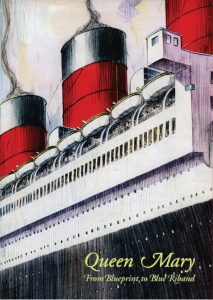
QUEEN MARY:
Blueprint to Blue Riband

Cover for Queen Mary Blueprint to Blue Riband bookCunard has long been synonymous with the best in trans-Atlantic travel. Many of the company’s liners have won the Blue Riband. A proud boast is that the company has the best safety record of the lines and liners that have crossed the Atlantic.

Cunard have owned and operated many famous liners over the years – Campania, Lucania, Lusitania, Mauretania, Queen Mary, Queen Elizabeth, or more recently the new generation of Queens.

But of all of these liners, in over 175 years of Cunard history, there is one name above all others that is connected with Cunard – Queen Mary.

Queen Mary‘s design and construction

This volume covers the early years of Queen Mary. From when she was first planned to when she wrestled the record for the fastest Atlantic crossing from her French rival Normandie. There are stunning photographs, many previously unpublished. The reader is taken step-by-step through the design, construction and fitting out of the liner.

Maiden voyage and Blue Riband

Her entry into service and the maiden voyage is thoroughly covered. The highlight of the season was gaining the Blue Riband in August 1936, after new propellers were fitted. 

This slideshow requires JavaScript.

192 pages with 500 photographs. £38.00 plus shipping


CLICK HERE TO RETURN TO OVERVIEW PAGE

MAJESTIC:
White Star’s largest liner

Cover for Majestic bookA hardback book covering the design, construction and service of White Star Line’s express liner Majestic.

Built by Blohm & Voss for Hamburg America, Bismarck was to have been the third of Albert Ballin’s planned trio of super liners, designed to dominate the North Atlantic .

Although launched, sadly the tragic outbreak of the Great War in August 1914 interrupted her completion, and throughout the war she lay at her builders, only half-built.

Reparations then to White Star Line as Majestic

Following the Armistice, the still-incomplete liner was ceded to White Star as reparations, and was completed by the builders. Once finished, she was renamed Majestic, and finally entered the prestigious trans-Atlantic service to New York, although she never competed for the Blue Riband.

Popular for a number of years, she generally enjoyed good passenger numbers. However, the quotas imposed on immigrants by the US authorities, coupled with Prohibition and the Great Depression, impacted on her success. Her grand interiors and immense size were redolent of an era that had passed.

With the merger of Cunard and White Star in 1934, the combined fleet was rapidly culled to effect the necessary economies to enable the new company to survive, and in 1936 it was announced that she was to be scrapped.

Conversion to HMS Caledonia

At the last minute she was sold to the British Admiralty and extensively converted into a training establishment for young seamen and artificers, as HMS Caledonia. Moored at Rosyth, she caught fire soon after the declaration of World War II and was gutted.

This slideshow requires JavaScript.

206 pages plus three A3 throw-out deck plans. £42.00 plus shipping


CLICK HERE TO RETURN TO OVERVIEW PAGE

LEGENDARY LINERS:
1881–1969

Cover for Legendary Liners bookThis book represents an eclectic choice – the author’s personal favourite historic, legendary liners. The hardest part was in deciding which liners to leave out!
There have been so many famous  liners since the late Victorian era. The development of reliable, economical engines and the inclusion of a second propeller meant that liners no longer needed to be equipped with sails and associated rigging.

Interiors became ever more luxurious, menus were more inventive, safety increasingly important. Hulls became ever larger, decks more numerous. More dining rooms were added, plus cafés, gymnasiums, winter gardens, swimming pools, libraries and many other facilities designed to help passengers make the best use of their time aboard.

Final selection of Legendary Liners

Ships have been chosen from many of the companies operating around the world. The result is this fascinating page-by-page account of the most famous liners from nearly 100 years of maritime history.

This slideshow requires JavaScript.

162 pages. £38.00 plus shipping


CLICK HERE TO RETURN TO OVERVIEW PAGE

BERENGARIA:
Cunard’s Happy Ship

Cover for Berengaria bookA hardback book covering the design, construction and service of Cunard’s popular express liner Berengaria.

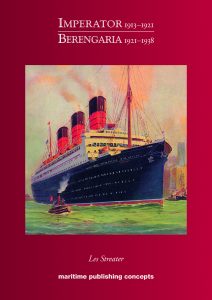
Hamburg-America’s Albert Ballin dreamed of building a trio of liners to dominate the North Atlantic. Launched in May 1912 at Blohm & Voss, Imperator was completed in April 1913. An enormous eagle was mounted on the bow to ensure that she would be longer than Cunard’s Aquitania! On her trials she had problems with her turbines and her stability and emergency work was needed before she could enter service. During her first refit in early 1914 some of the top weight was taken out to try to improve stability, and internal changes were made.

The Great War

Imperator was laid up in Hamburg in August 1914, and in April 1919 was handed over to the Americans. She was used by them, named USS Imperator, as a troopship, before being laid up in New York. Transferred to Britain as part of the war reparations in November 1921, she was allocated to Cunard.

Cunard’s Berengaria

The first commercial voyage for Cunard, as RMS Imperator, was in February 1920. She was renamed Berengaria in February 1921, after being converted to oil burning.  Although never fast enough to compete for the Blue Riband, she was always popular on the North Atlantic service. Regularly enjoying high passenger numbers, she was successful for a number of years. After a series of fires in 1938 she was laid up, and eventually was scrapped in November 1938.

This slideshow requires JavaScript.

196 pages plus three A3 throw-out deck plans. £38.00 plus shipping


CLICK HERE TO RETURN TO OVERVIEW PAGE

AQUITANIA:
Cunard’s Greatest Dream

aqui-coverA hardback book covering the design, construction and service of Cunard’s four-funnelled express liner Aquitania.

There were only ever fourteen four-funnel express liners in mari­time history. Some of these were short-lived, some went in a blaze of publicity, others worked long and hard for their owners. One of the most enduring and endearing of these was Aquitania. Her first three commercial North Atlantic crossings in 1914 were a triumph. Then the dark clouds of war descended and life changed.

The Great War

Aquitania proudly gave four years of service to her country, first as an armed merchant cruiser, then as a troopship and finally as a hospital ship.

Aquitania’s peacetime service

Once the hostilities were over, Aquitania resumed her peacetime service and quickly became popular with all classes of travellers. Although she never fought for the Blue Riband, she was still one of the fastest liners on the route. Increasing US immigration restrictions, Prohibition, the Great Depression: all flowed over her as she plowed a steady, profitable furrow across the Atlantic. Short and long cruises were incorporated into her schedules without pausing.

World War II

With the advent of yet another war, she was soon requisitioned as a troopship, giving six years of hard work around the world.

Peacetime again

Her last few years after World War Two were  repatriating American and Canadian troops, German prisoners of war and war brides, before carrying emigrants to their new lives in a new world. She was finally scrapped in 1950, the last of her type, a true historic liner.

This slideshow requires JavaScript.

162 pages plus three A3 throw-out deck plans.
£38.00
plus shipping


CLICK HERE TO RETURN TO OVERVIEW PAGE