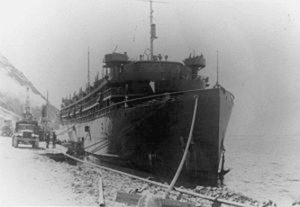
 SS Dorchester was a troopship allocated to the US Army during World War II. She was one of three ships in a class built by Newport News Shipbuilding: the keel was laid on 10th September 1925 and she was launched on 20th March 1926. Handed over to Merchants and Miners Transportation on 17th July 1926, she could carry 302 passengers in First Class and 3,300 tons of cargo on a coastal service between Miami and Boston.
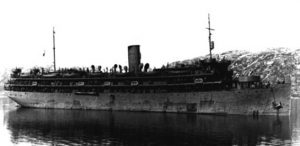 She had been taken over by the US War Shipping Administration on 24th January 1942 and converted to a troopship: additional lifeboats and life rafts were fitted along with four 20mm guns, a 3-in 50-calibre gun forward and a 4-in 50-calibre gun aft. After conversion she could carry over 900 troops. She entered service in February 1942, still with her original captain and crew, plus a contingent of US Navy personnel to handle the guns and communications. However, she was not owned or chartered by the Army so was not officially classified as USAT. She sailed from New York on 23rd January 1943 heading for Greenland, in a convoy of three ships, SG-19, with an escort of three US Coast Guard cutters. In the early hours of 3rd February 1943, Dorchester was torpedoed off Newfoundland by the German submarine U-223, and she sank in around 20 minutes. The explosion was severe, with an immediate loss of all power and communications. One of the cutters, Escanaba, moved in and managed to save 133, and another cutter, Comanche, saved 97 of the 904 personnel aboard. The water was freezing cold and the air temperature just 34°F: many died from hypothermia. The sinking of Dorchester was the worst single loss of American personnel in any American convoy during the war and the third worst loss of life at sea suffered by the US.
However, Dorchester is best remembered for the four Army chaplains who gave up their lifejackets and their lives to help others survive, seeing many into the lifeboats. These were a Methodist minister, George Fox, a Reformed Church minister, Clark Poling, a Catholic priest, John Washington, and a Rabbi, Alexander Goode. When there were no more boats or lifejackets, they were seen to link arms, say prayers and sing hymns together. On 19th December 1944 all four chaplains were posthumously awarded the Purple Heart and the Distinguished Service Cross. Congress wanted to grant the Medal of Honor but the condition for that award required heroism when under fire. In honour of their sacrifice the US Congress later declared 3rd February to be established as “Four Chaplains Day”, and in 1960 a special medal for heroism, the Chaplain’s Medal, was created.

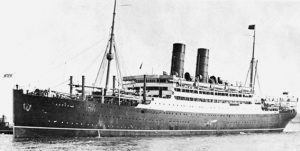 Immediately prior to the Great War, Cunard introduced a class of three liners: Andania, Alaunia and Aurania, for the Canadian service. These were twin-funnelled liners; the first two were built by Scott’s of Greenock and the third by Swan, Hunter. They were twin-screw vessels of 13,500grt, 540 feet long, and could carry over 500 passengers in Second Class and over 1,600 in Third Class. None were to survive the war. The grey photograph is of Aurania, the other is of the sister, Andania.
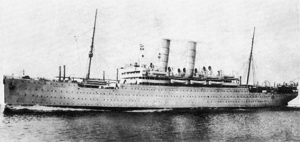 Aurania was launched on 16th July 1916, but was completed as a troopship. She made her maiden voyage on 28th March 1917, from Newcastle to New York. After only seven trips, she left Liverpool on 3rd February, travelling in ballast for New York, to collect troops and munitions. On 4th February 1918 she was torpedoed by the German submarine UB-67, some 15 nautical miles north of the Irish coast. Badly damaged, she was taken in tow by a trawler, but ran aground on the rocks off Tobermory and was declared a total loss. Eight died in the tragedy.
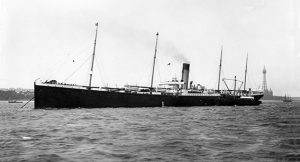 Launched at Harland & Wolff, Belfast on 16th November 1898 as Yard Number 322, Afric was handed over to White Star on 2nd February 1899. She was the first of three sisters: Afric, Medic and Persic. These vessels were 550 feet long, 11,948grt, twin propeller vessels. As well as carrying 320 Cabin Class passengers, she could carry 15,000 tons of general cargo and had 240,000 cubic feet of refrigerated space for up to 100,000 carcasses of Australian meat.
 With the outbreak of the Great War, Afric was one of the first liners to be requisitioned, as HM Transport A19, and in October was in the first convoy to bring Australian and New Zealand troops to the war in Europe. In April 1915 Afric was converted at Sydney to carry over 500 troops and 500 horses. On 12th February 1917, en route from Liverpool to Plymouth then Sydney, she was torpedoed and sunk by UC66 off the Eddystone Lighthouse. Five were killed in the explosion and a further 17 drowned.
 Republic left Liverpool for New York on her maiden voyage on 1st February 1872. Built at Harland & Wolff, Belfast, she had accommodation for 166 in First Class and 1,000 in Third Class. Launched on 4th July 1871 she was fitted for sail as well as an engine from Forrester’s. On her first trip, Captain Murray was not impressed by the quality of construction, and on his return sent in a damning report to the company. There is no apparent record of the company’s – or Belfast’s – reaction! In October 1872 she was transferred to the new steamer service to South America.
 With new ships joining the fleet, in 1888 Republic was put up for sale. On her final voyage for White Star she ran aground off Sandy Hook but was refloated, then once she had docked part of the boiler exploded. On her return to the UK she was laid up at Birkenhead, and in June 1889 sold to Holland America as Maasdam. She was refitted and given new engines.
 In August 1902 she was sold to La Veloce of Genoa and renamed Vittoria, running from Genoa to New York on the emigrant service, carrying 1,424 in steerage. Some time later she was renamed Citta di Napoli, for the same owners. She was laid up in 1908 and was scrapped at Genoa in 1910.
 On 31st January 1903 Harland & Wolff, Belfast handed over Cedric to White Star. She had been launched on 21st August 1902, and at the time was the largest ship in the world. As built, her accommodation was listed as 365 in First Class, 160 in Second Class and 2,352 in Third Class. She also had an enormous cargo capacity. Under Captain Haddock, she made her maiden voyage from Liverpool to New York on 11th February 1903.
 Over her career Cedric had numerous collisions and incidents, mostly relatively minor. She also had the misfortune to encounter a number of severe storms. In March 1904 she was delayed three days by one storm, suffering damage. A year later in another storm she was swamped by three giant waves and took eleven days to complete the crossing. In another storm, in January 1912, some waves were described as over 60 feet high: a number of lifeboats were destroyed. In March 1924 she met a severe storm, Captain Marshall said it was one of the worst trips he had ever experienced.
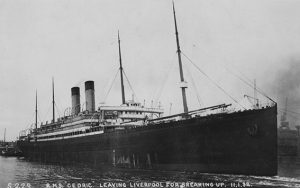 Cedric was requisitioned in November 1914 to serve as a troopship and armed merchant cruiser, but was released in January 1916. In April 1917 she was again requisitioned, as a troopship. In January 1918 while in Convoy HG47 she rammed Canadian Pacific’s Montreal, which sank: a later enquiry found the cause was improper navigation by Cedric. She was returned to White Star in December 1918 and returned to commercial service. During her career she was rebuilt a number of times, with various changes to accommodation and configuration. Finally in January 1932 she was sold to Ward’s and was scrapped at Inverkeithing.
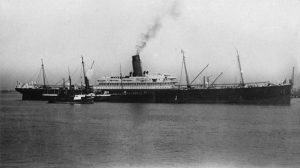 Minnetonka was built at Harland & Wolff’s Belfast yard for Atlantic Transport. Launched on 12th December 1901, she was completed by early July 1902. Her maiden voyage was from London to New York on 12th July 1902. She was one of the first ships to be fitted with wireless, a Marconi system: her call letters were MMK.
 Following the outbreak of the Great War she was requisitioned in May 1915 as a troopship, as HMT158. She was attacked by submarine U35 on 2nd February 1917, while in the Mediterranean, but successfully escaped. Later that year she was attacked on 24th September by the German submarine UC34 but again escaped successfully.
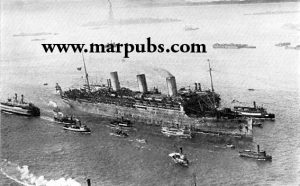 Leviathan arrived at Brest, France on 23rd February 1919 to collect the next contingent of troops to be repatriated. This turned out to be the 27th Division, also known as “New York’s Own”, formed in 1908 as the New York Division of the National Guard.
 The Division boarded on 25th February and sailed the next day, with a total of 9,714 troops, 133 NCOs, 319 officers, 66 nurses and 151 others. More of the 27th Division travelled on Mauretania. To avoid bad weather they took a more southerly course which added two days to the journey.
 She arrived at New York on 6th March, and was met by a flotilla headed by the city’s Mayor. Aircraft flew overhead and thousands gathered along the shore in a great welcome. There had been a strike among the harbour workmen which looked likely to spoil the arrival, but after a direct appeal by the city officials, the union agreed to furnish volunteers – in the end crews for everything were provided at no expense to the vessel’s owners!
 Following the recent financial problems in the Far East, such as Hanjin, another massive loss has been reported. This time it is China’s COSCO Shipping Holdings, which has admitted it expected to post a loss of $1.44 billion for 2016, blaming the weak condition of the freight market, and low returns from disposing of assets. COSCO, which is state-owned, claims that freight rates had started to recover in the fourth quarter of 2016.
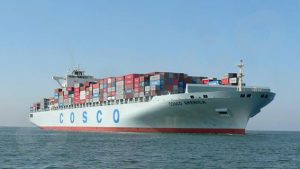 In 2015 COSCO had made a healthy profit, but declining freight rates had reversed this. As part of its efforts to control the losses, it sold off its dry bulk business and other divisions while restructuring. This was part of a merging of China Ocean Shipping Group and China Shipping Group. On the Hong Kong Exchange COSCO’s shares dropped 0.34% on the news of the loss.
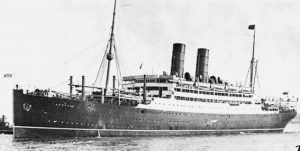 On 27th January 1918, Cunard’s Andania was hit by a torpedo from the German submarine U-46. She was some two miles off Rathlin lighthouse; attempts were made to tow her to safety but she sank some hours later. She had around 40 passengers and 200 crew; all bar seven crew were saved.
 The Russian Ministry of Transport is in talks with the Sovfracht Group and Rosmorport, to create a regular passenger service from Sochi to Novorossiysk, Yalta, Sevastopol and back to Sochi. It is said that President Putin is taking a close interest in the project: in September 2016 he ordered the Ministry to organise the 2017 tourist season, covering air and maritime traffic to the Crimea. To inaugurate the service, it is planned to use Roy Star, a former ferry that is 142m long and built originally to cary 750 passengers. Provisional estimates to acquire the vessel, refurbish it and establish the service are given as 700 million roubles (just over £9 million). Ticket prices for the cruise are estimated to be around 4,500 roubles per day.