
 After pleading guilty to illegally dumping oil at sea, and then trying to cover it up, Carnival’s Princess Cruises was recently fined $40 million. This latest incident involved Caribbean Princess, following information gathered by the UK’s Maritime and Coastguard Agency (MCA) from an unhappy engineer aboard the vessel when it arrived at Southampton in August 2016.
The MCA shared the information with the US Coast Guard, who inspected Caribbean Princess when it arrived at New York in September 2016. The Chief Engineer and Senior First Engineer had hidden the apparatus used, and made the other engineers agree to lie about the methods. However the Coast Guard established that the dumping had been going on since 2005, initially using an unauthorised valve to dump waste, and later using a “magic pipe”. One of the worst incidents was the dumping of over 4,000 gallons of oil whilst only 23 miles off the English coast.
Similar practices were found on four other Princess ships, and included routinely clearing oily bilge water and bilge waste whilst near land.
 This court action followed a similar case in October, when two German shipping companies, part of Bockstiegel Reederei, pleaded guilty in the US federal court to illegally dumping waste and were fined $750,000. And in September two Greek shipping companies, Oceanic and Oceanfleet, were convicted of illegal dumping oily waste in the Pacific. In March 2016 two other German companies, part of Briese Schiffahrts, were similarly fined $1.25 million plus a $250,000 community service charge for using a “magic pipe” to discharge oily waste.
The US Environmental Protection Agency is continuously checking all vessels in US waters in attempt to improve water quality and the environment.
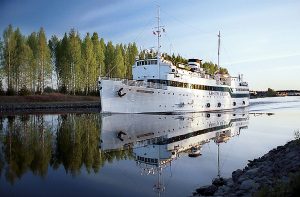 Originally built in 1943 as US patrol craft escort/submarine chaser PCE-830 by Pullman-Standard in Chicago, she was transferred the following year to the Royal Navy and renamed HMS Kilchrenan. After war service, in 1946 she was briefly returned to the US navy, as USS Kilchrenan before being sold in 1947 to HSD in Bergen, Norway. She was rebuilt for use as a local freight and coastal passenger ship and renamed Sunnhordland.
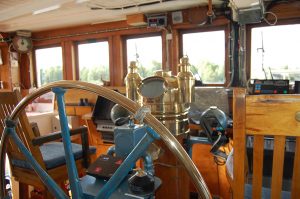 In 1973 she was laid up and then sold the following year to Oy Fager Lines of Helsinki and renamed Kristina Brahe, later abbreviated to Brahe, sailing on the Finnish lakes. She changed hands several more times over the following years, until in November 2016 she was sold to become a museum ship in Leirvik in Norway, between Stavanger and Bergen. She is to be renamed Sunnhordland.
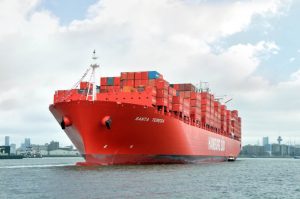 It was announced on 1st December 2016 that the Danish company Maersk, said to be the world’s largest shipping company, is to buy Hamburg-Süd.
 Once one of the premier companies on the route from Europe to South America, Hamburg-Süd was founded in 1871 by a combination of German and British entrepreneurs. It was well-known in the first half of the 20th century for operating such liners as Cap Arcona, Cap Trafalgar, Cap Polonio and Cap Norte.
 In a later statement, on 13th December, Maersk confirmed that the acquisition and operation of Hamburg-Süd would hopefully replace around 60% of the revenue that will be lost when Moller-Maersk separates off its Energy Division, to leave itself free to concentrate on transport and logistics. Last year the Energy Division added $9.8 billion to the conglomerate’s revenue: it is anticipated that Hamburg-Süd will generate some $6 billion.
 One of the best sources for ocean liner memorabilia and artefacts is The Purser’s Locker, owned by collector and dealer Jonathan Quayle. As well as a beautiful website detailing the many items he has for sale, he also features an occasional blog with fascinating items of information. The latest covers original items from Queen Mary‘s maiden voyage in 1936.
 Reuters reported on 2nd December 2016 that heavy winds had forced a Russian cargo ship to run aground off the coast of Istanbul. Footage released at the time showed crew getting into lifeboats although there were no reports of any injuries. No further news was released on damage suffered or eventual fate of the vessel.
 A new cruise company, Croisières M/S Jacques Cartier, Inc., is being established shortly to operate a service on the St Lawrence river by the summer of 2018. They have purchased the Jacques Cartier, which has been operating on the St Lawrence as a tour boat for the last 40 years. The owners plan to offer “active cruises” which will include kayaking, geocaching and zodiac excursions.
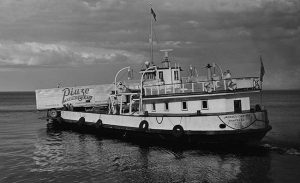 Built in 1924 at Lauzon, this little vessel has had a chequered career and many rebuilds since, including new engines in 1955 and a complete rebuild in 1975. She had been retired in 2012, but is now undergoing a complete rebuild and refit to carry 66 passengers. It will include an observation room, a spa, a sauna and the zodiacs for local excursions.
 A former presidential yacht, the USS Sequoia, was used by US presidents from Herbert Hoover to Jimmy Carter for entertaining diplomats or just getting away from the stress of Washington. It has now been sold for nothing. Zero. Nil dollars!
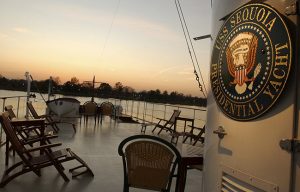 Jimmy Carter sold the yacht in 1977 at an auction, for $286,000. It was then moored at a marina in Washington, DC, and used for four-hour charter tours along the Potomac River. It has changed owners several times since, but in recent years the wooden yacht has been quietly rotting away at a shipyard in Deltaville, Virginia, steadily deteriorating.
 It was reported in November 2016 that the Croatian shipbuilder Brodosplit was to build a new polar expedition vessel for Oceanwide Expeditions. The provisional name has been announced as Hondius.
 Viking Line Abp (Finnish Ferries, not the riverboats) have ordered a large new cruise ferry from China. They signed a letter of intent with Xiamen Shipbuilding on 23rd November 2016, for delivery in the Spring of 2020. The final agreement is expected to be signed in Spring 2017, and will include an option for a second vessel.
 On 21st November 2016 STX France cut the first pieces of steel for Celebrity’s new build, planned for delivery in 2018, and to be called Celebrity Edge. This will be the first of four vessels in this class. Each is 117,000 tons and will carry 2,900 passengers.