 On 14th January 1899 Oceanic (yard number 317) was launched at Harland & Wolff,. She was designed as a twin-propeller, steel-hulled vessel, with two sets of triple-expansion engines producing 28,000hp. Accommodation was 300 First Class, 190 Second Class and 1,000 Third Class.
 On 26th August she left Belfast for Liverpool. Oceanic sailed from Liverpool on her maiden voyage on 6th September, with 1,456 passengers. However, because many of the stokers were untrained, she made the crossing with the engines operating at 75% of their potential and arrived at Sandy Hook on 15th September, at an average 19.57 knots. Oceanic left New York on 20th September on the return leg.
Oceanic was involved in a number of incidents throughout her career. She went aground in fog off Three Castles Head, Ireland on 9th October 1900. Early on 8th August 1901, in thick fog off Tuskar Light, Oceanic collided with the cross-channel steamer Kincora, which quickly sank, taking seven of her crew. Oceanic made her first sailing from Southampton on 19th June 1907.
On 1st August 1914 Oceanic sailed from New York,, with 1,000 passengers, 6,000 sacks of mail and $6 million in gold, and arrived at Southampton, and on 8th August she was requisitioned as an Armed Merchant Cruiser. On 25th August HMS Oceanic sailed to join the 10th Cruiser Squadron at Orkney, to patrol the Western Approaches. However, there was some evidence of “abnormal difference of deviation” on her compasses when so far north. At this time the regular Merchant Navy captain was still aboard each cruiser, but under a Royal Navy captain, with inevitable clashes over matters of authority.
 On 8th September Oceanic was on patrol. The naval captain, William Hayter, ordered a course to pass between the island of Foula and the Shaalds. The White Star captain, Henry Smith, strongly advised against going into such shallow water, but was over-ruled. Subsequently Oceanic ran aground: the crew were quickly transferred to Alsatian. It proved impossible to pull her off the rocks, and in the end it was accepted she was a total constructive loss. The guns and ammunition were removed and the instruments dismantled. Amazingly, at the later enquiry both captains were absolved of all blame!
On 25th August 1916 an auction was held at Southampton of fixtures and fittings that had been removed in late 1914. In early 1924 the wreck was sold to Scapa Flow Salvage and Shipbreaking Co. for just £200. However, after only one dive, it was clear the local currents made any salvage impossible.
Extracted from “White Star: the Company and the Ships”
CLICK HERE TO GO TO OVERVIEW PAGE ON OUR BOOKS

 On 17th January 1923 Olympic arrived at New York with Assistant Commander E.R. White in command. Olympic had sailed from Southampton on 10th January, under Captain Hambelton, on his final voyage before retiring after 36 years with White Star. He collapsed on the bridge the following day, having suffered two gastric hæmorrhages, and made the rest of the crossing under the care of the ship’s doctor. Arriving at New York, Captain Hambelton was immediately taken by ambulance to a private hospital in Manhattan. Captain H.F. David, his successor as captain of Olympic, had been on board as an observer during the westbound crossing, and took command on the eastbound crossing. After treatment at the hospital, Captain Hambelton returned to the UK on 10th February, as a passenger aboardc. He retired immediately on his return. He died in a nursing home in Golders Green, London, on 27th April 1929.
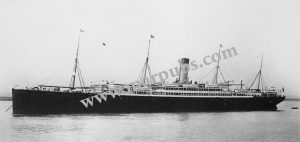 Ionic (II) was built by Harland and Wolff (yard number 346) in December 1902 for the joint White Star/Shaw, Savill & Albion service to New Zealand. She began her maiden voyage on 16th January 1903, from London to Wellington. She arrived at Wellington on 5th March, and left on 16th April for the return trip. In August 1914 Shaw, Savill & Albion ships changed their inbound port of call from Plymouth to Southampton, with Ionic being first to do so.
 During a refit in 1929, the accommodation was converted to Cabin Class and Third Class only. In 1932 White Star’s Australian service passed to Shaw, Savill & Albion, together with Ionic and Ceramic, plus Mamilius (ex-Zealandic). Although the corporate entities had merged, operations continued unchanged but White Star had no further interest. Subsequently she was rebuilt with Tourist Class accommodation only for 280 passengers. On 9th September 1936 Ionic left Avonmouth for New Zealand on her last sailing. Having sailed over 2 million miles, she was sold for scrapping on 6th January 1937 for £31,500. She left Liverpool for Osaka, arriving on 16th June, and soon after was dismantled.
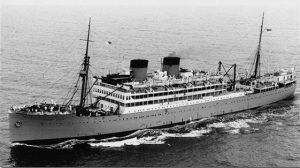 Llangibby Castle was built in 1929 for Union Castle by Harland & Wolff at Govan. A motorship, she was 485 feet long and 11,951grt, and was principally used on the “Round Africa” service. She was requisitioned in July 1940, and converted into a troopship, initially transporting troops to South Africa. She was damaged in an air raid on Liverpool in December 1940 but was quickly repaired.
 She was in Convoy WS-15, which sailed on 12th January 1942 from Liverpool and the Clyde for Durban, via Freetown. On 16th January Llangibby Castle was torpedoed by U-402, just north of the Azores. The torpedo blew off part of the stern, including her after gun, and her rudder and killed 26 men, but she remained afloat. In spite of repeated air attacks, and using her propellers to steer, she managed to reach Horta, Portugal, on 19th January.
 After emergency repairs, she sailed for Gibraltar, arriving on 8th February, having fought off several U-boat attacks, where she landed her troops. Finally on 6th April, after some repairs but still without a rudder, she sailed for the UK, arriving on 13th April, escorted by three destroyers. Llangibby Castle had sailed some 3,400 miles without a rudder, an amazing feat which earned her captain a CBE.
 On 31st March 1935 Cunard-White Star stated: “Olympic will drop out of the trans-Atlantic trade for the summer season”, and a series of cruises were proposed. Olympic departed from New York for Southampton on 5th April 1935 on her last passenger-carrying voyage. Arriving at Southampton on 12th April, she was towed to Berth 108 in the Western Docks, where she was laid up, ahead of Mauretania.
 She was bought on 10th September 1935 by Sir John Jarvis for £97,500, who then sold her on to Thomas Ward’s, to be scrapped at Jarrow, which had been badly affected by unemployment. Under Captain P.R. Vaughn, Olympic left Southampton on 11th October, and arrived at Palmer’s Yard, Jarrow, on 13th October. Cut down to the waterline, Olympic was towed to Inverkeithing for final demolition on 19th September 1937.
 On 29th July 1914, Kronprinz Wilhelm arrived in New York and proceeded to refuel and reprovision as usual. Two days later NDL ordered her to load additional large amounts of coal and fresh water. Then on 1st August NDL cancelled Kronprinz Wilhelm’s next sailing scheduled for 4th August. In the meantime they continued to load fuel wherever they could. Portholes and windows were sealed and blacked out. She then sailed, to become one of Germany’s armed raiders, seizing a number of vessels.
 On 14th January Captain Thierfelder seized the Nelson liner Highland Brae, on passage from England to Buenos Aires with two thousand tons of coal, five hundred tons of fresh water and additional provisions. The passengers were transferred to Kronprinz Wilhelm. This meant that the raider now had some 219 prisoners on board that needed guarding and were consuming the limited supplies of food and water.
 13th January was twice a significant date in Normandie’s history, and both were connected with fires on Normandie. The first was in 1935: there had been several incidents of sabotage reported in the final months of her fitting out. On 13th January 1935 a patrolling supervisor noticed some panelling in a corridor was loose: behind them he found the electrical wiring had been tampered with, enough to create a series of short-circuits and possibly start a fire. Some of the electrical conduits had needles inserted, others had been cut and some had been removed entirely. The supervisor raised the alarm, then quickly assembled a specialist team of skilled electricians who checked and repaired every conduit throughout the ship. It was never discovered who had caused the damage or why.
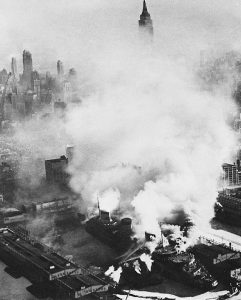 The second incident was on 13th January 1942. A survey had been ordered into the ability of the ship to fight a fire. The survey, by Walter Kidde & Co., was very superficial – they only checked a few of the hundreds of extinguishers on board, before declaring that they were not built ‘according to American design’, and recommended that all be replaced with American units. However, nothing was put in hand. The comprehensive fire alarm system had been disconnected. And tragically the ship-to-shore fire alarm link to the New York City Fire Department had been cancelled once Normandie was taken over, and the Navy didn’t consider it necessary to replace it.
 All the French-made hose couplings on the water main for the firefighting system were being changed to American-pattern couplings: workers ignored an instruction to retain compatible couplings, so a mixture developed of different couplings, although the original fittings on the hoses remained. Most of the French firemen had left when the US took over the ship: the civilian ‘fire watchers’ that replaced them were totally untrained in the equipment aboard or emergency procedures. This created confusion and mayhem. And the result was the devastating loss of Normandie!
 On 13th January 1915, the armed merchant cruiser HMS Viknor disappeared off the Irish coast, with no distress messages ever heard. It was later assumed she hit a mine and was a sudden, devastating loss.
 She was launched in September 1888 as RMS Atrato, by Napier & Son in Glasgow, for the Royal Mail Steam Packet Co. When completed she was a single screw steamer fitted with a three-cylinder triple-expansion engine but was also rigged as a three-masted schooner. She displaced 5,386 tons, and was 421 feet long. With her clipper bow and raking masts, she looked more like a luxury yacht. She could carry 176 First Class passengers and 400 in steerage, on the service between Southampton and South America, and then to the Caribbean. The maiden voyage was on 17th January 1889, to Buenos Aires. In October 1912 she was sold to Viking Cruising Company of London and renamed Viking, to operate cruises in northern Europe.
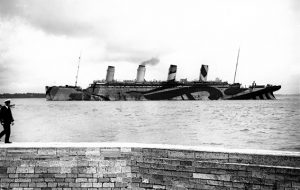 Olympic arrived at Belfast on 12th January 1917 for a three months’ refit, which included fitting six 6-in guns, with 40 Royal Naval ratings allocated. Two guns were mounted on the fo’castle, two in the forward well deck and two aft on the poop deck. She had a new dazzle camouflage scheme designed by the war artist Norman Wilkinson, one of several patterns she sported during the war. During the overhaul, Captain Hayes was given temporary command of Celtic.
 Following the aborted voyage on Celtic, Captain Hayes commanded Adriatic on one voyage to New York then returned to command of Olympic. On 4th April 1918 Olympic was re-commissioned. She was due to sail from Greenock for Halifax with all cabins full and over 2,000 passengers. However she was held for several days waiting for a political delegation headed by Arthur J. Balfour, British Foreign Secretary and head of the British Mission to the United States. On 2nd June Mr Balfour and his mission boarded Olympic at Halifax for the return voyage. Captain Hayes was later awarded the CMG for this duty.
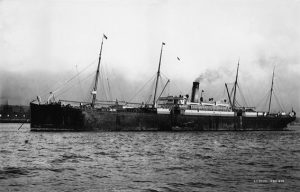 On 12th January 1894, White Star’s Cevic sailed on her maiden voyage from Liverpool to New York. She had been launched on 23rd September 1893 at Harland & Wolff, as yard number 270. Built as a large cattle carrier, she could carry 800 head of cattle and 20 horses, as well as having a large cargo capacity. She sailed from New York on 30th January 1894, with what was claimed to be the largest cargo to leave the port at that time. On 1st February she rescued the crew of a sinking brig, W.G. Gordon. En route from Liverpool to New York, on 15th November 1895 Cevic encountered a 90mph gale which tossed the ship so violently that barrels in the hold broke loose!
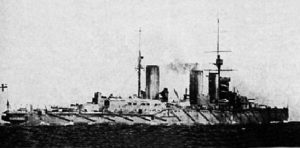 She was requisitioned by the Admiralty in October 1914, and was sent to Belfast, where she was converted into a dummy battleship, HMS Queen Mary. This was as part of a fleet of merchant ships converted to resemble various warships. After grounding twice she finally left Belfast on 13th April 1915. The disguised warships were not particularly successful, and in September 1915 Cevic was purchased by the Admiralty and converted into a Royal Fleet Auxiliary tanker. Renamed Bayol, she was renamed again in 1917, becoming Bayleaf. On 18th February 1918 she was severely damaged by bad weather and repairs took over three months. In June 1920 she was purchased by British Tanker Co. then re-sold to Anglo-Saxon Petroleum and renamed Pyrula. By November 1921 she was a floating depot ship in New York harbour, and by September 1925 she was being used as a hulk at Curacoa, as a bunker ship. Finally on 25th July 1933 Pyrula was sold to Henrico Haupt and scrapped at Genoa.