
On 6th March 1941 the German battleships Scharnhorst and Gneisenau rendezvoused with the U-124, under Captain Schulz. The warships had been tailing the British convoy SL67, a group of 54 mainly cargo ships heading from India to the UK. The convoy was escorted by a British battleship, HMS Malaya, plus two destroyers and a corvette, and several AMCs. The German High Command had issued an order forbidding any of their capital ships from attacking convoys guarded by Allied capital ships, so the information about the convoy and its route was passed to the submarine. Soon after U124 met up with U105, under Captain Schewe, and they formulated an attack plan. Together, they moved in at dawn, off the Cape Verde islands.
 Schewe was the first to fire, torpedoing the British & South American’s cargo ship Harmodius. She had a cargo of pig iron; one DEMS gunner and 15 Lascar crew were lost, survivors were eventually landed at Gibraltar.
 Schulz then moved in and in a single attack fired four bow tubes and both stern tubes. He first sank British India’s Nardana, which had a general cargo from Bombay; three officers and 16 Lascar crew died.
 Next was P&Os Lahore, with a general cargo of timber and pig iron, caught fire in the attack and was abandoned, but there were no casualties.
 Weir’s Tielbank had a general cargo that included manganese ingots; four crew died in the attack.
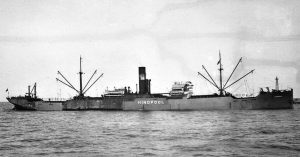 Ropner’s Hindpool was last. She had a cargo of pig iron; the captain and 27 crew lost their lives.
All were lost within twenty minutes. The escorts moved in, forcing the U-boats to crash dive, and they lost contact with the convoy, which was saved by further losses. The commanders of the German battleships had hoped the submarines would sink or disable HMS Malaya, so that they could move in and destroy more of the cargo ships, but the swift action of the escorts had prevented this. U105 then met up with U106 and they proceeded to attack another convoy, SL68, sinking eight ships in that convoy on 16th March.
 On 8th March 1917 the Norwegian collier Storstad was shelled and sunk. She was some 45 nautical miles off Fastnet Rock when she was attacked by the German submarine U-62. Storstad had been built in 1910 by Armstrong, Whitworth at Newcastle, with a strengthened hull: she was 440 feet long, 6,028grt. At the time of the attack she was carrying a cargo of maize from Buenos Aires to Rotterdam, as part of the Belgian Relief Effort. In spite of this, the submarine fired 12 shells from her deck gun, then torpedoed her.
 Several years earlier Storstad had gained notoriety when, in dense fog, she had rammed and sunk the Canadian Pacific liner Empress of Ireland, in the St Lawrence. The liner had sailed from Quebec on 28th May 1914, with 1,057 passengers and a crew of 420. In the ensuing disaster over 1,000 people died, either in the collision or in the freezing waters. More passengers were lost in this collision than on Titanic, but in the deteriorating events in Europe it was quickly forgotten.
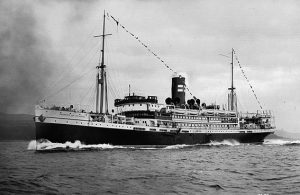 The Príncipe de Asturias, built at Russells in Port Glasgow, was owned by the Spanish company Naviere Pinilllos. She was launched in April 1914, with an older sister, Infanta Isabel, launched in 1912. They were some of the most luxurious liners built in this Edwardian period of splendid ships! Sailing from Barcelona to Buenos Aires, they stopped at several intermediate ports en route. She was 460 feet long, with quadruple expansion engines and twin propellers giving a service speed of 18 knots, and was 8,371grt. Her maiden voyage was 16th August 1914, and she was an immediate success.
 Príncipe de Asturias sailed from Barcelona on 17th February 1916, her sixth voyage, stopping at Valencia, Cadiz and Las Palmas, with 558 passengers and nearly 200 crew aboard. Her cargo included several thousand ingots of tin, lead, iron and copper, plus 20 large bronze statues destined for a large statue to be erected in Buenos Aires to commemorate the centenary of its independence. However, on 5th March 1916, sailing at speed in dense fog near the island of Sao Sebastiao while heading for the port of Santos in Brazil, she ran onto a reef. Within minutes she was listing at such an angle it was impossible to launch the lifeboats, and the weather was too bad. In the resulting tragedy, 445 died, one of the worst maritime incidents of the early years of the 20th century.
 On 5th March 1936 King Edward VIII (formerly the Prince of Wales) paid an extended tour of inspection of Queen Mary, at the shipyard. He was accompanied by Donald Skiffington, the shipyard director. He not only visited the Cabin Class areas as planned, he then insisted on touring the rest of the ship including the third class and the crew’s quarters. In all he spent over three hours aboard.
 When the King and his party left, the ship’s sirens sounded for the first time, in salute to the occasion. In his private diary, the King later recorded: “The completion of … Queen Mary was an important public event in 1936. Early in March, while the vessel was undergoing her final fitting-out, I travelled to Glasgow with the object of calling the world’s attention to this stupendous product of British industrial skill.”
 Completion of Queen Elizabeth had been delayed at John Brown’s yard, as essential workers were diverted to work for the Royal Navy. However the UK government was aware of German interest in the new liner, and were concerned at maintaining her security and safety. Space at the yard was now desperately needed for warships. Finally, although not completed internally, on 26th February 1940 Queen Elizabeth made her way down the Clyde, using one of the few high tides to help her. That evening she anchored off the Tail of the Bank, and on 28th February completed very brief sea trials, after which Cunard officially took delivery. News sources released a false story that the liner was due to head for Southampton, and apparently the Germans accepted this, and even carried out extra raids on the docks, hoping to catch her.
 In the early hours of 2nd March 1940, an Admiralty messenger boarded Queen Elizabeth, anchored in the Clyde, carrying sealed orders. The day before Cunard had been formally notified that Queen Mary had been requisitioned, and now Queen Elizabeth was to join her. The orders were opened and soon after, with an escort of four destroyers plus air cover, she headed out into the Atlantic. The escorts couldn’t keep up and soon detached, and the new troopship raced across the Atlantic, using her speed on untested engines to evade submarines.
 Queen Elizabeth arrived at Ambrose light vessel in the early morning of 7th March, and harbour tugs escorted her to Pier 90, where she joined Queen Mary, Mauretania and Aquitania, plus CGT’s Normandie and Île de France, and the Italian liner Rex. Once docked, the grey camouflage paint was touched up, supplies taken aboard and other preparations made for her coming war service.
 White Star’s Oceanic, under Captain Digby Murray, sailed from Liverpool on 2nd March 1871, heading for Queenstown and then New York. She had 64 passengers aboard. Soon after she left, the crankshaft bearings in the engine started to overheat, and Oceanic was forced to put into Holyhead. After temporary repairs, she returned to Liverpool for a full repair.
 She was fitted with a 4-cylinder double expansion compound engine with 12 boilers, and was designed to have a service speed of 14 knots. A notable feature of her design was that passenger accommodation was in the more stable amidships area. Prior to this most vessels’ accommodation was at the stern, where passengers experienced more turbulence, vibration and noise.
 In a ceremony at the White House on 1st March 1913, US President William H. Taft presented a Congressional Gold Medal to Captain Arthur H. Rostron, in recognition of his rescue of Titanic’s survivors. The award had been approved by Congress on 6th July 1912, to Captain Rostron, the officers and crew of the steamship Carpathia, “for promptly going to the relief of the steamship Titanic and heroically saving the lives of seven hundred and four people who had been shipwrecked in the North Atlantic”.
 Gaelic, the second vessel of that name, was launched at Harland & Wolff’s Belfast yard on 28th February 1885. She was handed over to White Star on 18th July 1885, for use on the joint White Star/Occidental & Oriental trans-Pacific route. Under Captain Pearne, she sailed from Liverpool on 28th July, heading for Hong Kong, then Yokohama and on to San Francisco. She arrived at her destination on 30th October. She then settled into her regular commercial service from San Francisco to Yokohama, running alongside her sister ship, Belgic.
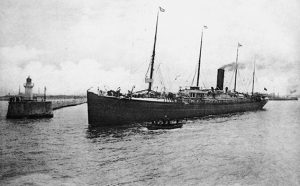 At this time the transport and sale of opium was legal, and Gaelic often carried large cargoes. On 10th January 1902 she arrived at San Francisco with over £1 million of opium aboard plus other valuable commodities. She made her final departure from San Francisco on 13th December 1904, heading for Hong Kong and then the UK. On her arrival, she was sent to Belfast for a refit, and was then sold on to Pacific Steam Navigation, who renamed her Callao, for their service from Liverpool to Callao in Peru. Her accommodation was now 83 First, 44 Second and 280 Third Class. Finally, in September 1907 Callao was broken up in South Wales.
 In a recent statement from P&O Cruises Australia, the cruiseship Pacific Dawn has now entered a Singapore drydock to begin a multi-million dollar rebuild. There will be a number of new features installed, including a waterpark and two waterslides. The traditional ship’s buffet is to be replaced by a group of fresh food outlets in an area to be called The Pantry. Other changes in the food offerings include a restaurant called Nic and Toni’s, which will specialise in Mediterranean-inspired dishes, a poolside Grill and a seafood restaurant to be known as Shell and Bones. The various theatres and entertainment areas are also being refurbished.
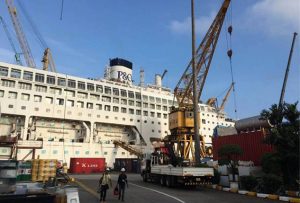 Pacific Dawn is expected to leave the drydock in early March and to be back at Brisbane by 16th March, with the first cruise leaving on 1st April. No announcement was made about bookings for her planned itinerary for early March. Pacific Dawn is based at Brisbane, Queensland, and was built at Fincantieri in 1991, as Regal Princess.
 White Star’s Britannic was launched at Harland & Wolff, Belfast, as Yard No 433, on 26th February 1914. A large group of prominent guests and journalists had been brought over from Liverpool on Patriotic, chartered from Belfast Steamship. The day was cold, with a steady drizzle, but that didn’t dampen the celebrations. After the launch 12 tugs moved the hull round to the deep-water fitting out berth, where work immediately began on completing her.
 Work on the third liner in the trio had proceeded swiftly: framing had been complete by 27th February 1913, and the hull was fully plated by 20th September. However, with the outbreak of the Great War, work was halted as Admiralty contracts took precedence, and materials and skilled workers were needed on other vessels. Then in May 1915 the Admiralty, desperate for large troopships and hospital ships, enquired about Olympic and Britannic. White Star confirmed that it would take approximately 12 weeks to complete Britannic to a state where she could be used as a troopship, and that Olympic was available immediately. The Admiralty requisitioned Britannic on 13th November 1915, to be completed as a hospital ship. Many of the fittings already in place were removed and put in storage, and the missing gantry davits were replaced by six Welin davits. It was said that the cost of the conversion amounted to £90,000.
 Britannic sailed for Liverpool on 11th December 1915, under Captain Ranson, where she was formally commissioned as HMHS Britannic. Olympic was in port, so this would be one of only a few times the two sisters would be together. For the next ten days, medical stores and equipment were loaded, and the medical staff arrived. Britannic finally sailed on 23rd December 1915, bound for Naples and Mudros.