
 On 21st March 1938 a formal statement was issued by Cunard, announcing that Berengaria was to be permanently withdrawn from service and placing her up for sale. No serious offers were received, because everyone was aware of the expense of the rebuild, to enable her to regain the necessary certification for passenger-carrying.
 Berengaria had suffered a number of fires, many in her later years as the insulation on the wiring broke down. A major fire had broken out on 3rd March 1938, while she was docked in New York, resulting in serious damage to many areas – even some deck plates were buckled. Following an inspection by the US Steamboat Inspection Service, her certificate of seaworthiness for US passengers was revoked. Berengaria sailed for Southampton on 4th March, empty of all passengers, many of whom had been transferred to Queen Mary, along with most of the stewards.
 Once in Southampton repairs were started, but after another fire on 16th March Cunard accepted that Berengaria was not worth the cost of the necessary repairs and rebuild. Berengaria was towed to Berth 108 in Southampton’s Western Docks and laid up, awaiting a decision. No interest was shown in purchasing her, as all the other companies were aware of the state of the wiring and the costs that would be involved in refitting such an old vessel. On 19th October, it was publicly announced that she was to be sold for scrap. Berengaria finally sailed from Southampton on 6th December, heading for Jarrow on the Tyne.
 Asturias was built by Harland & Wolff for Royal Mail Steam Packet Co., running from Southampton to Buenos Aires. Completed in 1908, she could carry 432 passengers in First Class, 223 in Second Class and 775 in Third Class, with a crew of 254. She was 365 feet long, 12,000grt. Requisitioned at the outbreak of the Great War, Asturias was converted to a hospital ship for 896 patients, although she generally carried considerably more. HMHS Asturias initially served at Gallipoli, Egypt and Salonika, carrying sick and injured back to the UK. Later she served on the cross-Channel route for injured troops from France.
 On 20th March 1917, having unloaded over 1,000 troops at Avonmouth, HMHS Asturias was en route to Southampton, with all lights burning and the Red Cross markings clearly lit. In spite of this she was attacked by the German submarine UC-66. Badly damaged by a torpedo, the captain managed to beach his vessel near Bolt Head. Thirty-one aboard had been killed in the attack, with a further 12 missing. After inspection she was declared a total loss. However, later the government bought the wreck and salvaged her, and she was used as a floating ammunition hulk at Plymouth Harbour.
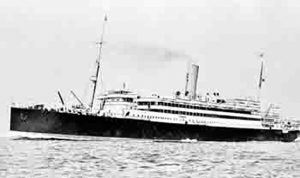 After the war, Royal Mail purchased the hulk and she was extensively refitted at Harland & Wolff and then returned to service as Arcadian, in 1923. She was used operating luxury cruises to the Mediterranean and Scandinavia, before she was finally laid up in October 1930. She was scrapped in Japan in February 1933, sailing to the scrappers in convoy with White Star’s Baltic and Megantic.
 After a major refit at Vulkan, Imperator sailed for New York on 11th March 1914 on her first sailing of the new season, under a new captain, Theo Kier. However, in mid-Atlantic she encountered a ferocious storm, and the captain was forced to reduce speed to below three knots for some time, just to maintain headway.
 In the evening a huge wave hit the bow: Imperator‘s eagle figurehead was badly damaged and four lifeboats were ripped off the fo’castle. On her arrival in New York on 19th March, an inspection of the storm damage found that one wing of the eagle had disappeared totally and the other wing was lodged under the anchor chain.
 Imperator left New York on schedule, and returned to Cuxhaven on 27th March. Two days later the remains of the massive gilt figurehead were removed, and gilt scrollwork, similar to that on the stern, was substituted. However, her official length in the various registers was never adjusted! The stability problems were never completely corrected, but overall the improvements had worked. How much the loss of the eagle helped was not recorded.
 After her final scheduled crossing of the season, in November 1913 Imperator was sent back to the yard for the work to be put in hand. The Grill Room and its heavy fittings were ripped out and replaced by a Verandah Café with lightweight furniture. Much of the heavy panelling in staterooms was replaced by lighter materials, marble baths, etc., were removed. Over 2,000 tons of cement were poured into the double bottom to lower the centre of gravity, and many other measures were effected. Total cost of the refit and other improvements amounted to over £200,000, a not-insignificant sum in 1914, all of which had to be met by the shipyard under the terms of a five-year guarantee.
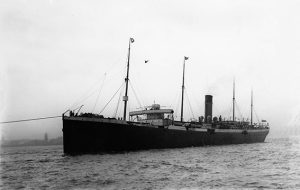 White Star’s Suevic left Melbourne for Liverpool on 2nd February 1907, under Captain Jones. This was to be his last voyage before retirement. Suevic sailed from Tenerife for Plymouth on 13th March, and by 17th March 1907 was nearing the Lizard. The weather had deteriorated with dense fog and this was a dangerous area for rocks and shoals. Misjudging the distance from the lighthouse, the Captain maintained full speed. Around 11.30pm Suevic ran onto Maenheere Rocks, off Lizard Point. Lifeboats were sent out, Suevic lowered its own lifeboats and all passengers were taken ashore. Salvage teams were unable to prise the vessel off the rocks, so passengers’ luggage and much of the cargo was removed.
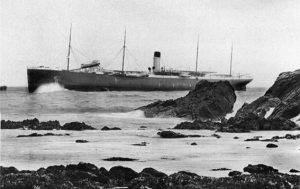 Damage was confined to the bow section: the stern with the valuable engines and accommodation was undamaged. White Star decided to attempt the salvage: the plan was to use some 300 small charges of dynamite to separate the two sections, just aft of the bridge, leaving the wrecked bows on the rocks.
 On 2nd April, a final blast separated Suevic into two and the stern floated free. After being made seaworthy, the stern section headed to Southampton, towed by the tugs Ranger, Herculaneum and Blazer, with another tug, Linnet, steering from astern. On 4th April, the stern section arrived at Southampton and was moved to No. 6 Graving Dock, pumped out and inspected. The Board of Trade Inquiry into the grounding found that Captain Jones had failed to navigate with “proper and seamanlike care” and suspended Jones’ certificate for three months, but he had retired soon after the accident.
 At Harland & Wolff, a new bow section was built from the original plans, and launched on 5th October 1907. It was complete, even including masts and rigging, with two lifeboats already in place and the bridge fully equipped. Towed stern-first by the paddle tug Pathfinder leading, with the tug Blazer following, Suevic’s new bow left Belfast on 19th October for Southampton. It arrived at Southampton on 25th October, where J.I. Thorneycroft, which was leasing Harland & Wolff’s repair yard, were to graft the two sections together.
 On 4th November, the two sections were offered up to each other. Hydraulic rams were used to adjust the two sections until they were correctly aligned and then combined. On 8th January 1908 the rebuilt Suevic left Southampton’s drydock, bunkered and then headed for Liverpool. Ten months after her grounding, on 18th January 1908 Suevic sailed from London to resume her service to Australia.
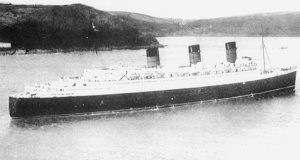 In March 1937, Cunard added Plymouth to Queen Mary‘s route for the eastbound crossing. This would enable anyone with urgent business to catch a fast train to London, rather than wait to arrive at Southampton. It was claimed this would save about 12 hours for passengers travelling to London. Initially the crossings for 10th and 24th March, and 7th and 21st April were included, with a total of nine calls made during 1937.
 The Italian hospital ship Po was sunk by a British torpedo bomber during a night raid on 14th March 1941, in the Bay of Valona, Albania. Apparently all lights were off on the ship, by order of the local naval command, who thought the darkness would provide better safety than illuminating the Red Cross markings. The attack was by five Royal Navy Fleet Air Arm Fairey Swordfish torpedo bombers from 815 Squadron, shore-based at Crete after HMS Illustrious was damaged. They were temporarily based at Paramythia in Greece. In the darkness, the attacking pilots were not aware that the ship was a hospital ship. In the attack 21 aboard died, including three nurses. Mussolini’s daughter, Edda Ciano, was aboard, working as a nurse for the Red Cross.
 Launched in 1911 as Wien, for Lloyd Austriaco, the ship was 454 feet long, 7,367grt, with two funnels and twin propellers. She had served as a hospital ship in the Great War. On 29th June 1916 she had run aground and damaged her propellers, after which she was returned to her owners. She was again requisitioned in December 1917, this time as an accommodation ship for German naval crews, and was based at Pola. During a raid by Italian frogmen on 1st November 1918, she was sunk.
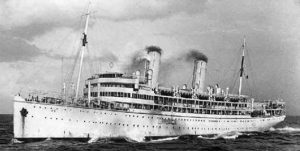 Raised in 1921, she was rebuilt and then renamed Vienna, for Lloyd Triestino. Renamed again in 1935, as Po, she was requisitioned in November 1940 and served as a hospital ship for the Italian navy. She had completed 14 missions as a hospital ship prior to the attack, mainly carrying wounded troops from the fighting in Libya and Albania. Apparently British policy was that, although larger hospital ships were protected under the Hague Convention, smaller ones were legitimate targets as they could be used to transport troops and to rescue crashed aircrew. In fact, all 11 Italian hospital ships were attacked at least once during World War II. Po has the rare distinction of being a hospital ship in both wars and of being sunk in both wars. The wreck was found in 2005.
 Late on 13th March 1943, Canadian Pacific’s Empress of Canada was hit on the starboard side by a torpedo from the Italian submarine Leonardo da Vinci, and quickly developed a list and lost all power. Within an hour another torpedo hit and she sank soon after, some 400 miles south of Cape Palmas. The final casualty toll was 44 crew, 8 guards and 340 passengers, ironically many of them Italian prisoners of war. An SOS had been transmitted and a Catalina flying boat found the lifeboats the next day. Rescue boats finally collected 1,360 survivors and took them to Freetown,.
 Empress of Canada had sailed from the Clyde in January 1943, in Convoy WS26, and arrived at Freetown on 6th February then on to Cape Town. Here the convoy split, and Empress of Canada headed for Durban, arriving on 25th February, where most of the troops aboard trans-shipped to smaller vessels. She left Durban on 1st March for Cape Town, carrying 1,346 passengers, mainly 500 Italian POWs and a number of Greek, Norwegian and Polish refugees.
 The liner had been built in 1922 by Fairfield’s at Govan. She was 653 feet long, 21,517grt. In peacetime she had operated on the trans-Pacific route for Canadian Pacific, based at Vancouver, as well as running a number of very successful and popular Round-the-World cruises. She was requisitioned in 1939 for use as a troopship, and after conversion had transported thousands of Australian and New Zealand troops
 Bayano was a banana boat owned by Elders & Fyffes. Built in 1913 by Alexander Stephen’s of Glasgow, she was requisitioned in November 1914 as an armed merchant cruiser, pendant number M78. She was equipped with two 6-in guns and some light armament, and attached to the 10th Cruiser Squadron. Under the command of Captain H.C. Carr, she was heading for Liverpool to refuel.
 Around 5.15am on 11th March 1915 Bayano was intercepted some three miles off Corsewall Point, near Stranraer by the German submarine U-27, under Lt. Cmdr. Bernd Wegener. Hit by a torpedo, Bayano sank very quickly, with the loss of her captain, 14 officers and 181 crew. Only four officers and 22 ratings were rescued.
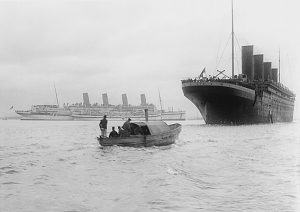 On 2nd September 1915 Olympic was requisitioned for use as a troopship, at the same rates as Cunard received: ten shillings per gross ton per month. She sailed from Liverpool on 24th September as HM Transport 2810, taking around 6,000 troops to Mudros for the Dardanelles campaign. Passing through the Mediterranean, on 1st October lookouts spotted a drifting lifeboat from the French vessel Provincia, with 34 survivors, sunk that morning by an Austrian submarine off Cape Matapan. Captain Hayes stopped long enough for the survivors to climb aboard. Two hours after she resumed her voyage, a submarine was spotted off the starboard bow, but Olympic was able to evade it: once the submarine was astern, the aft guns opened fire, and the submarine fired a torpedo. Both sides missed. Captain Hayes was later criticised by British authorities for risking the ship and the troops aboard by stopping in submarine-infested waters for the French survivors, but he was awarded the Médaille de Sauvetage en Or (2éme classe) by the French government.
 When Olympic arrived at Mudros on 2nd October, the system was disorganised, and it took eight days for all the troops to disembark. The chaos continued when Olympic arrived at Spezia for coal and fresh water. The pilot failed to appear, and Captain Hayes trid to enter the harbour. An Italian destroyer raced out to warn Hayes he was entering a minefield, and guided her to a berth. Once docked, it was found the port facilities could not handle a vessel the size of Olympic, and it took eight days to load sufficient coal for the return journey.
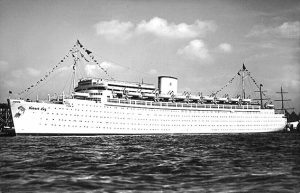 As part of Adolf Hitler’s dream of uniting all the German people behind him, soon after his election in 1933 he banned all trade unions and created the DAF (Deutsche Arbeitsfront – German Labour Front). Every German worker had to become a member. To encourage all the people to join the DAF, he then created the Kraft durch Freude (KdF – Strength Through Joy) organisation. This would offer German workers the opportunity to enjoy low-cost cruises as a reward for their efforts to rebuild and develop Germany. This had the added benefit of finding a use for the many ships and seamen that had been laid-up during the Great Depression. The scheme was a great success, and many well-known ships were used from Hapag, NDL and Hamburg-Sud. The Nazis realised their success, and decided to build two new vessels designed purely for cruising: these would be the Wilhelm Gustloff and the Robert Ley, both named after prominent Nazis. They were built as one-class only, so no passenger felt superior or inferior. Facilities included a swimming pool and a gymnasium, and passengers enjoyed an excellent cuisine. Excursions ashore were organised at each port of call.
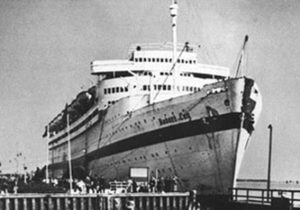 Robert Ley was launched by Adolf Hitler on 29th March 1938, at Howaldt shipyard in Hamburg. Although owned by DAF, she was managed by Hapag. Once completed she was handed over on 24th March 1939, and sailed soon after on her maiden cruise. In May 1939 Robert Ley was used to transport members of the Condor Legion – German troops who had fought in the Spanish Civil War – back to Germany. Events in Europe were now deteriorating, and on 25th August 1939 Robert Ley was converted into a hospital ship in preparation for the coming conflict. During the brief but bloody Polish campaign she was used to bring wounded troops back to Germany for treatment. With the collapse of Poland, Robert Ley was sent to Neustadt, where she was used as an accommodation ship for submarine crews for the next four years.
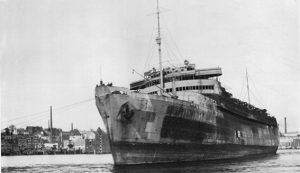 In January 1945, as the Soviet troops advanced rapidly from the east, the Nazis called on every available vessel to help evacuate thousands of troops – healthy, sick and wounded – as well as thousands of refugees, from the Eastern Zone, in Operation Hannibal. This call-up included Robert Ley, and for three months she was heavily involved. In early March 1945 she was returned to Hamburg. On 9th March the RAF conducted an intensive bombing raid on Hamburg, and during this Robert Ley caught fire and was quickly gutted. Not worth rebuilding, in June 1947 the hulk was towed to the UK, where she was scrapped at Inverkeithing.