
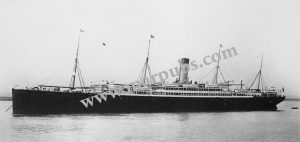
 Ionic (II) was built by Harland and Wolff (yard number 346) in December 1902 for the joint White Star/Shaw, Savill & Albion service to New Zealand. She began her maiden voyage on 16th January 1903, from London to Wellington. She arrived at Wellington on 5th March, and left on 16th April for the return trip. In August 1914 Shaw, Savill & Albion ships changed their inbound port of call from Plymouth to Southampton, with Ionic being first to do so.
With the declaration of the Great War both Australia and New Zealand volunteered to send troops. Among the first liners to be requisitioned were Medic, Afric and Ionic. A torpedo was fired at her in the Mediterranean on 31st December 1915 but it missed her by a matter of feet. Ionic returned to commercial service on 31st January 1919, after being operated under the Liner Requisition Scheme.
 During a refit in 1929, the accommodation was converted to Cabin Class and Third Class only. In 1932 White Star’s Australian service passed to Shaw, Savill & Albion, together with Ionic and Ceramic, plus Mamilius (ex-Zealandic). Although the corporate entities had merged, operations continued unchanged but White Star had no further interest. Subsequently she was rebuilt with Tourist Class accommodation only for 280 passengers. On 9th September 1936 Ionic left Avonmouth for New Zealand on her last sailing. Having sailed over 2 million miles, she was sold for scrapping on 6th January 1937 for £31,500. She left Liverpool for Osaka, arriving on 16th June, and soon after was dismantled.
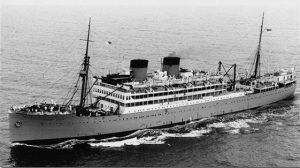 Llangibby Castle was built in 1929 for Union Castle by Harland & Wolff at Govan. A motorship, she was 485 feet long and 11,951grt, and was principally used on the “Round Africa” service. She was requisitioned in July 1940, and converted into a troopship, initially transporting troops to South Africa. She was damaged in an air raid on Liverpool in December 1940 but was quickly repaired.
 She was in Convoy WS-15, which sailed on 12th January 1942 from Liverpool and the Clyde for Durban, via Freetown. On 16th January Llangibby Castle was torpedoed by U-402, just north of the Azores. The torpedo blew off part of the stern, including her after gun, and her rudder and killed 26 men, but she remained afloat. In spite of repeated air attacks, and using her propellers to steer, she managed to reach Horta, Portugal, on 19th January.
 After emergency repairs, she sailed for Gibraltar, arriving on 8th February, having fought off several U-boat attacks, where she landed her troops. Finally on 6th April, after some repairs but still without a rudder, she sailed for the UK, arriving on 13th April, escorted by three destroyers. Llangibby Castle had sailed some 3,400 miles without a rudder, an amazing feat which earned her captain a CBE.