
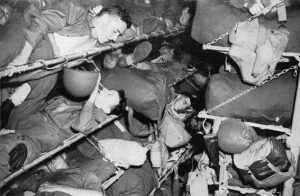
 In early January 1942 Queen Mary arrived at Boston and entered the drydock for a thorough overhaul. Cunard had handed over the running of both Queens to the Americans at a recent Arcadia conference in Washington. This meant Cunard provided and paid the crews, which the UK government refunded. The UK government paid all fuel and running costs. The US government provided the troops and their food. Accommodation aboard Queen Mary was increased again, with additional “standee” bunks crammed in wherever possible, and use made of “hot bunking” – as one soldier got up, another took his place. More kitchens and toilets were installed, with additional catering equipment, showers, etc. The armament was increased as well.
 Finally Queen Mary embarked her first contingent of US troops – 8,398 plus a crew of 905 – and on 18th February 1942 sailed from Boston to Key West. Here Captain Bisset came aboard, replacing Captain Townley, who was retiring. Leaving Key West on 25th February, she sailed for Rio de Janeiro, then headed across the South Atlantic to Cape Town, arriving on 14th March. She finally arrived at Sydney on 28th March 1942: this later became known amongst the troops as the “Forty Days and Forty Nights Cruise”!
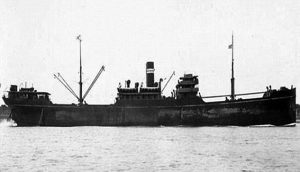 War Roebuck was a small cargo vessel built at Palmers, Jarrow in 1918. With the end of the Great War she was acquired by British India and was completed as Gairsoppa. Taken over at the outbreak of World War II, she sailed in several convoys before joining Convoy SL64 in February 1941, sailing from Calcutta, India to Liverpool, UK. Running low on coal while off the coast of Ireland, Gairsoppa separated from the convoy and headed for Galway, some 300 miles away, for more fuel. She was attacked and torpedoed by U-101 in the early hours of 17th February 1941, and sank within 20 minutes. Although 3 lifeboats got away, only one person survived, Second Officer Ayres; 83 others were lost.
 What made her of special interest was that she was carrying some 7 million ounces (200 tons) of silver, worth at that time over £600,000. In 2010 the UK government awarded a salvage contract to Odyssey to find the wreck and salvage the bullion. The company quickly found the wreck and began operations, and by July 2013 had recovered over110 tons, estimated at £137 million ($210 million) at current value.
 Athos was a two-funnelled cargo-passenger ship being built at Dunkirk for Messageries Maritimes when the Great War erupted. Once launched, she was towed to St Nazaire, where she was completed in November 1915 for use as a troopship. She was 513 feet long, and displaced 12,644grt. Her maiden voyage was to China, sailing on 28th November 1915, with a second voyage from Marseilles to Yokohama and back in late 1916.
 On 17th February 1917, while some 200 miles ESE of Malta, on her third voyage, she was torpedoed by German submarine U-65, commanded by Hermann von Fischel. She was carrying 1,950 people, including a large contingent of Senegalese soldiers, civilian passengers, 1,000 Chinese labourers and the crew. Athos sank in just 14 minutes, with the loss of 754 aboard, including the captain. The survivors were quickly picked up by escorting vessels.
 Runic, a specialist cattle-carrier, was handed over by Harland & Wolff to White Star on 16th February 1899. She made her maiden crossing from Liverpool to New York only five days later. On 28th May 1890 fire broke out aboard Runic while she was at Liverpool. The cargo hold had to be flooded to extinguish the fire, as she was carrying a highly-inflammable cargo of sulphur and caustic soda. Then on 17th July 1894 she rescued the crew of the barque Emma T. Crowell, shortly before she exploded.
 On 6th December 1917 Imo, while chartered to the Belgian Relief Commission, collided with Mont Blanc, which was carrying explosives, in Halifax harbour. The subsequent devastation was the largest man-made explosion at that time, with over 1,600 killed and a large area of the town destroyed. Mont Blanc was obliterated and the entire superstructure of Imo ripped off. Imo was later repaired, and then renamed Guvernoren, still as a whale oil tanker. Finally, on 30th November 1921 she ran aground off the Falkland Islands and was abandoned as a total loss.
 White Star’s Celtic sailed from Liverpool for New York on 14th February 1917. She was under the command of Captain Hayes, who had been temporarily transferred from Olympic. On 15th February she hit a mine laid by the German submarine U-80, under Captain Alfred von Glasenapp, off the Isle of Man. Seventeen crew on board were killed in the explosion. Most of the survivors were taken off by the railway ferry Slieve Bawn and taken to Holyhead. Despite a 30-foot hole in her side, Celtic remained afloat and was soon towed back to Liverpool. After temporary repairs she was sent to Harland & Wolff in Belfast where she was thoroughly repaired. She was back in service by the end of April, just in time to be requisitioned under the governmnet’s Liner Requisition Scheme.
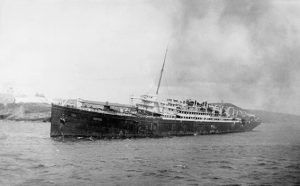 Celtic survived a number of incidents and collisions in her career, including a torpedo attack. She also encountered a number of severe storms, many causing damage. Her luck finally ran out on 10th December 1928 when, in poor visibility, she ran aground off Cobh harbour, and was later written off as a total loss.
 After delays leaving New York and troubles on the voyage, Leviathan finally arrived off the coast of Scotland on 3rd February 1938. But she had missed the spring tide, and had to anchor in Inverkeithing Bay on the north side of the Firth of Forth. Here she waited for the next suitable tide to see her under the Forth Bridge and able to get to Rosyth. On 4th February a local gale swept in and Leviathan dragged her anchors. Just before she went ashore the engineers managed to raise enough steam to get her back to her anchorage.
 On 12th February the time was favourable but a local gale meant Leviathan could not proceed safely. Then on 13th February, with tugs in attendance, Leviathan prepared to move. Suddenly an oil pipe burst in the boiler room and steam pressure was lost. Finally, on 14th February 1938, the tugs managed to gain control and towed her under the spectacular Forth Bridge. At 4.37pm that afternoon she was secured in the inner Admiralty Basin, near her sister, the one-time Bismarck, and the engine-room telegraphs were set to “Finished with engines”. The end had arrived.
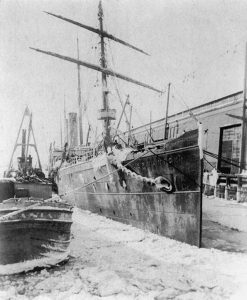 On 10th February 1899 the temperature in New York was down to –6°F (–21°C). The next day, White Star’s Germanic arrived at Pier 45 from Liverpool, covered in ice after sailing through severe gales and heavy snow during the crossing. The weight of ice on her decks, superstructure, masts and rigging had given her a 4 degree list to starboard, and the gangways had to be cleared using axes and steam hoses before the passengers could debark. For the next two days crew and dock workers struggled to clear the ice, in spite of further bad weather sweeping over the harbour. Coal barges had been brought alongside but were unable to offload, as the list had now increased to 10 degrees.
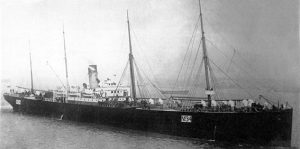 Nomadic, specially built as a livestock carrier, was launched at Harland & Wolff, Belfast on 11th February 1891. Completed with twin propellers and two triple-expansion engines, she was handed over on 14th April 1891. Her maiden voyage left Liverpool on 24th April 1891, and she arrived at New York on 5th May.
 She was quickly requisitioned in 1899 in preparation for the Boer War, as HM Transport 34. Nomadic made three trips to South Africa carrying horses for the cavalry, in October 1899, December 1899 and June 1900. After this she was released and returned to commercial service. In February 1903 Nomadic was transferred to another IMM company, Dominion Line, and in December 1903 was renamed Cornishman. In July 1921 she was transferred to Frederick Leyland & Co. but kept her name and stayed in Dominion livery. Finally in March 1926 she was sold to Ward’s and was broken up at Hayle in Cornwall.
 Cymric (Yard No. 316) was launched at Harland & Wolff, Belfast on 12th October 1897. Designed primarily as a cattle and horse transport, she could also carry around 100 passengers. She could also be adapted to carry around 1,500 passengers in steerage. Handed over on 5th February 1898, she was to be used primarily for passengers and not cattle. Cymric began her maiden voyage to New York on 11th February 1898, arriving on 22nd February after being severely delayed by bad weather.
 Cymric returned to the Liverpool to New York service in December 1914. On 23rd January 1916 Cymric arrived at New York with over $26 million in American securities aboard, plus $100,000 in gold. She was given a strong escort to protect her from submarines! She sailed from New York on 26th April 1916 with over 18,000 tons of munitions and war matériel. On 8th May she was hit by three torpedoes from German submarine U20, 140 miles WNW of Fastnet,and sank the next day: four crewmen died in the explosion.
 Queen Mary arrived at New York on 10th February 1946, bringing 1,700 GI brides and 650 children to their new lives in America. She had been converted in Southampton in January 1946, when a nursery and a playroom were installed, along with extra laundries. There were now cots in all rooms. The standee bunks in the First Class swimming pool were removed and the area was used as a drying room for hundreds of nappies (or diapers!). American Red Cross nurses, Army welfare officers and baby specialists were aboard to help the mothers. This was the first of a series of crossings known as ‘Operation Diaper’, which took in total nearly 13,000 GI brides across the Atlantic.
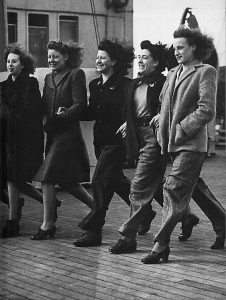 The Americans had organised two large camps near Southampton, where the mothers and babies were assembled some days before they were due to sail. Here they were given lectures on the American way of life, language differences and cultural changes they could expect. She had left Southampton on 4th February. Most of the women and children aboard had never seen so much food, or many of the varieties available, and quickly gorged themselves, in spite of being given warnings from the authorities.
 As Queen Mary arrived at New York, she had to plough through ice around Pier 90. On the quayside the 378th Army Service Forces Band played a selection of tunes to welcome the arrival of the brides – among their repertoire was Brahm’s Lullaby and Rock-A-Bye-Baby, all played eight to the bar! The welcome was appreciated by everyone aboard.