
 On 31st January 1903 Harland & Wolff, Belfast handed over Cedric to White Star. She had been launched on 21st August 1902, and at the time was the largest ship in the world. As built, her accommodation was listed as 365 in First Class, 160 in Second Class and 2,352 in Third Class. She also had an enormous cargo capacity. Under Captain Haddock, she made her maiden voyage from Liverpool to New York on 11th February 1903.
 Over her career Cedric had numerous collisions and incidents, mostly relatively minor. She also had the misfortune to encounter a number of severe storms. In March 1904 she was delayed three days by one storm, suffering damage. A year later in another storm she was swamped by three giant waves and took eleven days to complete the crossing. In another storm, in January 1912, some waves were described as over 60 feet high: a number of lifeboats were destroyed. In March 1924 she met a severe storm, Captain Marshall said it was one of the worst trips he had ever experienced.
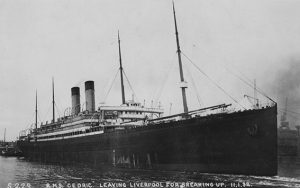 Cedric was requisitioned in November 1914 to serve as a troopship and armed merchant cruiser, but was released in January 1916. In April 1917 she was again requisitioned, as a troopship. In January 1918 while in Convoy HG47 she rammed Canadian Pacific’s Montreal, which sank: a later enquiry found the cause was improper navigation by Cedric. She was returned to White Star in December 1918 and returned to commercial service. During her career she was rebuilt a number of times, with various changes to accommodation and configuration. Finally in January 1932 she was sold to Ward’s and was scrapped at Inverkeithing.
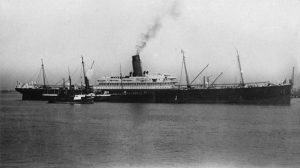 Minnetonka was built at Harland & Wolff’s Belfast yard for Atlantic Transport. Launched on 12th December 1901, she was completed by early July 1902. Her maiden voyage was from London to New York on 12th July 1902. She was one of the first ships to be fitted with wireless, a Marconi system: her call letters were MMK.
 Following the outbreak of the Great War she was requisitioned in May 1915 as a troopship, as HMT158. She was attacked by submarine U35 on 2nd February 1917, while in the Mediterranean, but successfully escaped. Later that year she was attacked on 24th September by the German submarine UC34 but again escaped successfully.
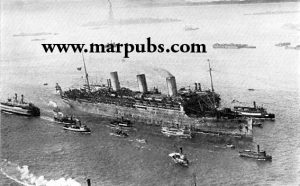 Leviathan arrived at Brest, France on 23rd February 1919 to collect the next contingent of troops to be repatriated. This turned out to be the 27th Division, also known as “New York’s Own”, formed in 1908 as the New York Division of the National Guard.
 The Division boarded on 25th February and sailed the next day, with a total of 9,714 troops, 133 NCOs, 319 officers, 66 nurses and 151 others. More of the 27th Division travelled on Mauretania. To avoid bad weather they took a more southerly course which added two days to the journey.
 She arrived at New York on 6th March, and was met by a flotilla headed by the city’s Mayor. Aircraft flew overhead and thousands gathered along the shore in a great welcome. There had been a strike among the harbour workmen which looked likely to spoil the arrival, but after a direct appeal by the city officials, the union agreed to furnish volunteers – in the end crews for everything were provided at no expense to the vessel’s owners!
 Following the recent financial problems in the Far East, such as Hanjin, another massive loss has been reported. This time it is China’s COSCO Shipping Holdings, which has admitted it expected to post a loss of $1.44 billion for 2016, blaming the weak condition of the freight market, and low returns from disposing of assets. COSCO, which is state-owned, claims that freight rates had started to recover in the fourth quarter of 2016.
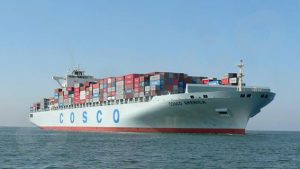 In 2015 COSCO had made a healthy profit, but declining freight rates had reversed this. As part of its efforts to control the losses, it sold off its dry bulk business and other divisions while restructuring. This was part of a merging of China Ocean Shipping Group and China Shipping Group. On the Hong Kong Exchange COSCO’s shares dropped 0.34% on the news of the loss.
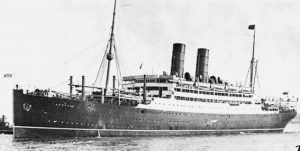 On 27th January 1918, Cunard’s Andania was hit by a torpedo from the German submarine U-46. She was some two miles off Rathlin lighthouse; attempts were made to tow her to safety but she sank some hours later. She had around 40 passengers and 200 crew; all bar seven crew were saved.
 The Russian Ministry of Transport is in talks with the Sovfracht Group and Rosmorport, to create a regular passenger service from Sochi to Novorossiysk, Yalta, Sevastopol and back to Sochi. It is said that President Putin is taking a close interest in the project: in September 2016 he ordered the Ministry to organise the 2017 tourist season, covering air and maritime traffic to the Crimea. To inaugurate the service, it is planned to use Roy Star, a former ferry that is 142m long and built originally to cary 750 passengers. Provisional estimates to acquire the vessel, refurbish it and establish the service are given as 700 million roubles (just over £9 million). Ticket prices for the cruise are estimated to be around 4,500 roubles per day.
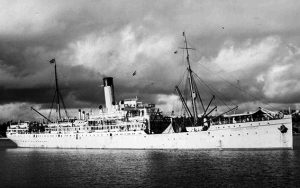 Union Castle’s Durham Castle was completed in February 1904 at Fairfield’s Govan yard, She was built for the Union Castle East Africa service from Cape Town to Mombasa, and was 475 feet long, 8,240grt. During the Great War she primarily remained on her commercial service, occasionally being used as a troopship. She was popular and regular vessel, and was finally withdrawn from service in 1939. Union Castle put her up for disposal, having replaced her with Pretoria Castle. She was purchased in August 1939 by Metal Industries for scrapping at Rosyth.
 After the outbreak of World War II, on 2nd October she was acquired by the Admiralty for use as an accommodation ship at Scapa Flow. Some other reports say she was to be used as a store ship or even as a blockship. On 26th January 1940 she was being towed by HMS Watermeyer to Scapa Flow when she hit a mine off Cromarty and sank. The weather was atrocious, with a gale blowing and icy conditions. There were no casualties. The mine was probably laid by the German submarine U57, under Captain Claus Korth.
 Canadian Pacific’s Empress of Canada had arrived at Liverpool on 10th January 1953 for her annual refit. Once complete, on 24th January she was moved from the drydock to Gladstone Dock. She was already well-booked for the coming season, as it was the Coronation Year in the UK. The next day, 25th January, there were around 250 workers aboard completing the final cleaning, plus a skeleton crew.
 That afternoon fire broke out on B Deck, and quickly spread. The fire was so intense 18 pumps were called in as well as a fire and salvage tug. Eventually there were over 40 units and 200 firemen on site. Firefighters had to wear breathing apparatus. At 10.00pm the order was given to abandon ship, and the firemen were ordered to concentrate on protecting the adjacent warehouses.
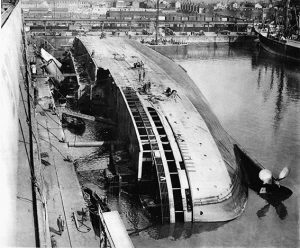 Early the next morning Empress of Canada capsized. She was soon declared a total loss, and salvage operations began. After removing all top hamper and sealing any openings, on 6th March 1954 she was rolled upright and then raised. On 14th September the remains were sold for scrapping at La Spezia, but the tow proved extremely difficult and she didn’t arrive until 10th October 1954, where she was finally demolished.
 En route from Liverpool to Halifax, on 25th January 1917 White Star’s Laurentic hit two mines that had been laid by German submarine U80 in Lough Swilly. She had 479 passengers aboard, mainly naval personnel, and £5 million in gold bullion, to be used to purchase war munitions. All told, 354 aboard died, many dying of exposure in their lifeboats in the freezing weather that night.
 Laurentic had been launched at Harland & Wolff, Belfast, on 9th September 1907, and could carry 230 in First, 430 in Second and 1,000 in Third, plus a large refrigerated cargo. She had a combination of two reciprocating engines and a low-pressure turbine, and was a test bed alongside her sister, Megantic, for the system to be installed in the Olympic Class. She had been requisitioned as a troopship on 13th September 1914.
 After the regular annual refit during December 1933, on 3rd January 1934 Aquitania returned to service. On her second departure from Southampton, on 24th January 1934 Aquitania ran aground off Calshot Spit in the Solent. The tide was still rising, and with the aid of several local tugs she was soon pulled free, and was able to resume her crossing.
 After her next annual refit, Aquitania resumed the trans-Atlantic run on 23rd January 1935. On 31st January she left New York for another Mediterranean cruise, which was repeated on 9th March. In April 1935, entering the Solent during a 60mph gale as she returned from her second cruise, she grounded again, this time on the Brambles mudbank, Thorne Knoll, in Southampton Water. With the tide already dropping, it was decided to take passengers off by tender, and gallons of fuel oil was pumped out to tenders brought alongside, in an attempt to lighten her. Although she was undamaged, it took a whole day – and eleven tugs – to successfully pull her off.