
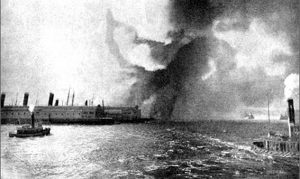
 Around 4·00pm on Saturday, 30th June 1900 fire broke out at Hoboken, in New York. Kaiser Wilhelm der Grosse and Main were at Pier 2, Bremen and Saale were at Pier 3. They were surrounded by coal barges, lighters and canal boats, laden with bales of cotton and drums of oil and petroleum products, including turpentine. An explosion amongst cargo on Pier 3 set stacked bales of cotton on fire: the flames spread rapidly. The fire spread fast on the dry, wooden piers; forty dockers died before they could run to safety. The flames jumped across adjacent piers before spreading ashore, destroying many buildings. Local fire crews responded but had little effect.
 None of the vessels had steam up, and were in danger of being destroyed. Harbour tugs moved in to help Kaiser Wilhelm der Grosse but were unable to move her. Admiral Dewey, one of the most powerful tugs in harbour, then arrived and started towing her clear. Another tug collected a second hawser and together they towed Kaiser Wilhelm der Grosse to the middle of the Hudson. Later Kaiser Wilhelm der Grosse was towed across the river. Damage was slight, mainly singed paint and woodwork.
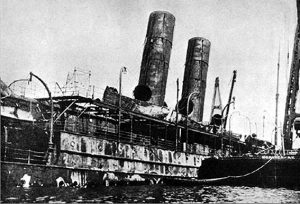 Two city fireboats, Van Wyck and New Yorker, arrived and played their firehoses on the burning liners, in a hopeless attempt to quell the fires and save some of those aboard. Saale was towed clear, blazing furiously. She was abandoned and left to drift, ending up near the Statue of Liberty and later sank: 109 crew died. Bremen and Main drifted clear and later both went aground at the Weehawken Flats: 12 died on one and 44 on the other. In total several hundred people died – exact figures were never accurately established.
 Damage to the three liners was severe. Around 27 barges and other river craft were destroyed and the three NDL piers and the Scandinavian-American (Thingvalla) Pier were gutted: several warehouses were burnt out. Insurance estimates totalled $4,627,000. One hundred victims were buried in a mass grave at the Flower Hill Cemetery in North Bergen, New Jersey. Bremen underwent temporary repairs before returning to Germany for a complete overhaul and was extended by 25 feet. Main was refloated and towed to Newport News, where she was repaired and returned to service with NDL. Saale was sold to Luckenbach Shipping and rebuilt as a freighter, J.L. Luckenbach, with a single funnel and new engines.
 Toyama Maru was a Japanese troop transport in World War II. On 18th June 1944 she left Moji, Japan in Convoy KATA-412, heading for Okinawa. There were troops of the 44th Independent Mixed Brigade aboard, plus a large cargo of petrol, stored in the lower holds in cans.
 At 7.30am on 29th June 1944 she was spotted off Taira Jima, Japan, by the US submarine USS Sturgeon, under Lt Cmdr Murphy. Four torpedoes were launched; three hit, one of which exploded the petrol. In the subsequent intense fire and explosions the hull broke in two, and she sank in a minute. Survivors were rescued by the escorts. Some reports say there were over 6,000 troops aboard, with 5,400 lost. Other reports say around 4,000 aboard with 3,674 lost. The latter is more credible, given the size of the ship. Original documents were destroyed by the Japanese at the end of the war, so the true figures will never be known. However, it is accepted as one of the ten worst maritime disasters in history.
 Toyama Maru was laid down on 4th August 1913 at the Mitsubishi Dockyard, for NYK Line. Completed on 3rd June 1915, she was 445 feet long, 7,089grt. In 1935 she was sold to Nanyo Kaiun, and some 18 months later sold to Ono Shoji Gomel. On 29th January 1941 she was requisitioned by the Japanese Imperial Army and assigned Army number 782. After being involved in several Pacific actions including the Philippines and Singapore, she was used to transport prisoners of war in the most appalling conditions. She was then transferred to transport Japanese troops to various theatres of war, until her final convoy.
 In June 1934 the Nazi Kraft durch Freude (KdF) organisation started operating tourist cruises, chartering German vessels. Dresden (ex-Zeppelin) sailed on her first KdF cruise on 11th June 1934, to Hardangerfjord. Because of heavy fog, the captain settled for a trip in Ryfylkefjords instead. Off Stavanger, Dresden picked up two local pilots. She was southbound when, on 20th June 1934, she struck a rock off Kopervik on the Norwegian island of Karmøy. She was able to back away from the rock, but was taking in water, and developed a list to port. However, she was sinking fast and he was forced to beach near Blikshavn on Karmøy.
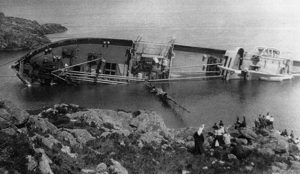 He ordered abandon ship, but as the first lifeboat was lowered into the water it capsized, throwing the occupants into the water and three women drowned. There was a fourth fatality during the evacuation, but the remainder of the crew of 323 and 975 passengers were saved. Around 500 were rescued by Captain Pallesen, who had brought Kronprinsesse Martha alongside. Other vessels soon arrived. The following day Dresden rolled onto her port side and sank, leaving only her starboard side visible. Salvage was impossible, and shipwreckers Brødrene Anda from Stavanger and a company from Grimstad bought the rights to salvage the scrap metal.
 Following several earlier unsuccessful attempts to develop an airmail system using Leviathan, in 1929 a further attempt was made. A large trap was built on the deck: this consisted of a frame attached to the top of the aft deckhouse on the Poop Deck, extending over the side of the ship. This frame was 35 feet wide, and contained a canvas trap. An aircraft would fly low overhead trailing a long cable to deliver and pick-up mail bags. The plan was for the pilot, Lt Cmdr George Pond, to rendezvous with Leviathan some 500 miles out from the US coast. Leviathan sailed from Southampton on 2nd June 1929 with 957 passengers, and was due to be at Grand Banks on 7th June, where the mail pick-up was to be attempted. On 5th June Pond crashed the plane at New York. A Loening seaplane was hastily fitted with the Adams pick-up fitting and he successfully took off. However, he encountered bad weather and lost his position, and soon after the aircraft was hit by lightning. He was forced to abandon the attempt.
 The next morning Pond attempted again. This time he was successful in finding Leviathan; unfortunately no-one had informed Leviathan of the repeat attempt so the system hadn’t been set up, and heavy fog hampered the attempt. Eventually the two bags of specially-franked mail were landed on the liner with the regular mail. The company decided to try again on the next crossing. Leviathan sailed on 12th June 1929 with 2,132 passengers. As she passed Fire Island, some 60 miles out, a small Fairchild monoplane flew overhead, piloted again by Pond from Keyport airport. This time he found Leviathan quite easily. On his first attempt, Pond dropped a bag of mail into the pick-up frame. The collection wasn’t quite as easy, and he had to make 13 attempts before he was successful in picking up and reeling in the mail bag from the Adams frame. A number of photographers were flying alongside to record the event.
 On 16th July Leviathan headed for Boston for her routine mid-season drydocking. During the trip another attempt was made to deliver and collect mail using the Adams frame but it was a failure. On the return trip an aircraft finally managed to drop four bags of mail onto Leviathan using the Adams system. However it was agreed the system was not that effective and soon after US Lines abandoned the whole idea.
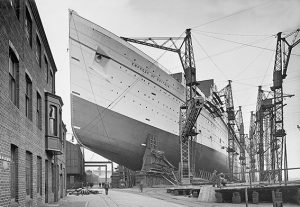 On 11th June 1930 Empress of Britain was launched at John Brown’s Shipyard at Glasgow. Most unusually the Prince of Wales, as Master of the Merchant Navy, agreed to launch the liner, accompanied by the Chairman and President of Canadian Pacific, Ed Beatty. Tugs towed the hull to the adjacent fitting out berth, where the next ten months would see feverish efforts to complete the liner.
 Much of the interiors had been completed before the launch. The major work was installing the engines and boilers, and finishing off the superstructure. There were four propellers, each driven by a single-reduction geared Parsons turbine. The inboard sets supplied two thirds of the total power, more than enough for the planned World cruises. Total output of the engines was 62,500shp for a service speed of 24 knots; this could be increased to 66,500shp if needed. Astern turbines were fitted to the two inboard turbines.
 Imperator finally left for her maiden voyage to New York on Tuesday, 10th June 1913, with Commodore Hans Ruser in overall command. Her maiden voyage had been delayed when she went aground soon after leaving the builders, then by a fire in a storeroom, followed by a boiler explosion. Finally, she sailed at 3.55pm, but immediately met a severe gale and heavy seas. When she arrived at Southampton on 11th June, she anchored off Ryde on the Isle of Wight, where she was given a full civic reception. She then sailed on to Cherbourg. She finally sailed for New York, with a total of 3,014 passengers aboard: 323 in First; 251 in Second; and 2,440 in Third and Steerage, plus 1,180 crew.
 The crossing was dogged by bad weather and fog, although the passengers were determined to enjoy themselves. The maiden voyage took 6 days 5 hours and 12 minutes, covering 3,153 miles and averaging 21·13 knots. Arriving on 18th June, she passed Nantucket lightship at 12·50pm and anchored overnight at Quarantine. Once the harbour pilot had boarded she headed for her pier at Hoboken, New Jersey, escorted by a large flotilla of small welcoming boats.
 On 3rd June 1916 British India’s Golconda was sunk by a mine laid by the German submarine UC-3, some 5 nautical miles off
  Golconda was a twin-funnelled, two-decked whaleback passenger vessel built in 1887 by