
A number of vessels were lost on 2nd January 1941, in what was one of the darkest years for merchant shipping and seamen during World War II. Just two of these are highlighted here:
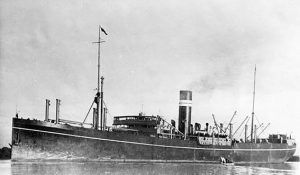 NALGORA of British India. She was 6,600grt, and 433 feet long, built by William Gray in 1922. Built to carry grain or cotton in bulk, she had no passenger accommodation. Whilst in Convoy OB 261, from Leith to Alexandria, she was sunk by stern torpedo and 70 rounds from deck gun from the German submarine U-65 in position 22°24’N 21°11’W at 22.07 hours , 350 miles north of the Cape Verde Islands. All crew survived.
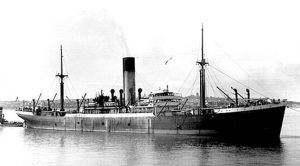 MERIONES of China Mutual. She was 7,557grt and 455 feet long, built by Palmers at Newcastle in 1922. She was in a convoy heading for Hull to complete loading cargo before heading for Australia. She grounded on a wreck on 22nd January 1941 and was abandoned. The crew were rescued by the Cromer lifeboat. Bombed by aircraft and sunk in position 52°53’N 01°47’E 26th January 1941, off Cromer.
Details of these and other vessels are in the book “Ships of the British Merchant Navy “– a fascinating summary of the careers of all vessels.
 STX France, based at St Nazaire in France, specialises in building large cruise ships. It is part of the troubled Korean shipbuilding conglomerate STX, which is currently in receivership. The Seoul bankruptcy court stated in November that four parties had expressed interest in taking over the French part of STX, but it has since confirmed that currently only one bid has been received. This is from the Italian shipbuilder Fincantieri.
 In spite of an apparently healthy order book, including the two recent orders from MSC, other yards have been hesitant to make a bid for the profitable shipbuilder. One of these, French naval contractor DCNS, admitted they had held talks with Fincantieri and were presently keeping their options open. Getting Hong Kong announced it was no longer interested.
 The French government has a 33% stake in STX France, but has made public that it is not interested in getting a majority stake. However, it insisted that it would be retaining its blocking powers on any changes, and would have a say in any ownership change. The French Industry Minister insisted that France would maintain its right to veto any sale if the conditions weren’t right.
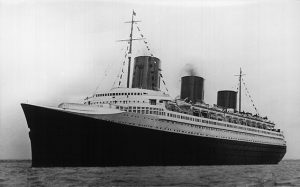 Following the Japanese attack on Pearl Harbor, on 22nd December 1941 Normandie was transferred to the US Navy Department, under the name of USS Lafayette, listed as AP53. To all who knew her, however, she would always Normandie. On the 24th December the Commission handed the liner to the US Navy, to to be hastily converted into a troopship, based on experiences gained with Queen Mary and Queen Elizabeth. The American need for troopships helped to speed up the bureaucracy. She was officially entered on the register on 1st January 1942.
 Plans were quickly put in hand for her conversion. Initially 18,000 bottles of wine were removed, along with many other items including six grand pianos, four hobby horses and other fixtures and fittings, most of which were later sold at public auctions. 2,400 vans were needed – transport costs alone were put at more than $100,000. Major works of art were carefully removed to storage, panelling was dismantled. Several local warehouses were rented for the storage. Robins Drydock was awarded the contract to convert her to a troopship, the work to be carried out while she was still at her pier. Sadly, following a number of bizarre decisions and careless workmen, on 9th February 1942 she caught fire, and later that day capsized. Too badly damaged and too big to be salvaged at the time, she was eventually scrapped in October 1946.
 Cunard’s Ivernia was built by Swan, Hunter & Wigham Richardson at Newcastle. She was launched on 21st September 1899, and made her maiden voyage from Liverpool to New York on 14th April 1900. There was an almost identical sister ship, Saxonia. Ivernia ran aground in thick fog off Daunts Rock on 24th May 1911, but was salvaged and later rebuilt. She returned to service on 17th October 1911. She was later used on the emigrant service from Trieste to New York.
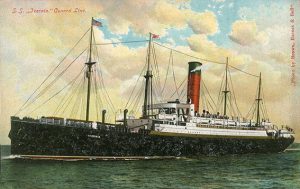 With the outbreak of the Great War in August 1914, Ivernia was hired by the UK government for use as a troop transport, mainly between Canada and the Mediterranean. On 28th December 1916 she sailed from Marseilles for Alexandria, Egypt, with HMS Rifleman as her escort. Carrying over 2,400 troops, mainly from the Argyle and Sutherland Highlanders, she was under the command of Captain Turner, who had previously been in command of Lusitania when she was torpedoed. On 1st January 1917 she was south-east of Cape Matapan, Greece, when she was torpedoed by the German submarine UB47. The torpedo hit on the starboard side and exploded in a boiler room, killing 22 of the crew. HMS Rifleman drew alongside and took off 666 troops and 36 crew, Other survivors were rescued by escorting trawlers. The ship sank soon after. Total casualties were 84 troops and 36 crew lost.
 After 31st December 1949 the name “White Star” disappeared from use. The two surviving White Star ships, Britannic and Georgic, would continue in White Star livery and fly the White Star burgee with Cunard’s house flag until the end of their careers, although the Cunard flag would now fly above the White Star burgee. Cunard-White Star, Ltd. continued for a while as a corporate identity, “largely as an investment company”.
 The US Coast Guard has officially called off the search for a 74-year-ol,d woman who went missing from Cunard’s Queen Mary 2 while on a 12-night Christmas and New Year cruise from New York to St Maarten in the Caribbean. Queen Mary 2 sailed from New York on 22nd December, but when the liner was about 100 miles off the Coast of New Jersey, the passenger was reported as missing.
 Built by Harland and Wolff at Belfast and launched on 28th June 1893, Gothic was jointly operated by White Star and Shaw Savill on the New Zealand service. She could carry 104 passengers in First Class and 114 in Steerage, and was intended to also carry a large cargo of refrigerated mutton and other goods to the UK. Her maiden voyage left London on 28th December 1893, under Captain Jennings.
 On 3rd June 1903 fire broke out in the cargo, and eventually she had to be beached off Plymouth and then scuttled, to extinguish the fire. She was later raised and given a thorough refit before returning to service. In 1907 she was transferred to Red Star Line and renamed Gothland. She later reverted to White Star and her old name, then in 1913 was back with Red Star as Gothland. In June 1914 she was stranded on the Scillies but was salvaged and repaired, and gave useful service in the Great War. Finally sold for scrap in 1925, she was broken up at Bo’ness in early 1926.
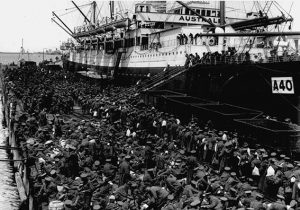 On 28th December 1914 the convoy for the Second Detachment of Australian and New Zealand Imperial Expeditionary Forces assembled at King George’s Sound at Albany. The majority of the fleet sailed on 31st December, and included Suevic (A29), Persic (A34) and Ceramic (A40), carrying troops and horses to Egypt.
 Persic had embarked the 5th Light Horse Regiment at Sydney on 21st December. Suevic had embarked the 6th Australian Light Horse Regiment. Leaving Fremantle for Colombo on 2nd January 1915, the three White Star ships were diverted to Aden for additional coal. The convoy reassembled at Aden on 24th January and reached Suez on 24th January. The troops were disembarked at Alexandria on 1st February.
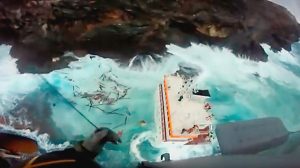 A general cargo ship, Cabrera, ran aground on the Greek island of Andros last Saturday, in heavy weather. The ship partially sank on the rocky coast, with very heavy surf. All nine crew members were lifted off by a Greek Navy helicopter and transferred to a local hospital.
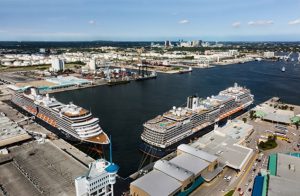 Federal authorisation has been granted for the US Army Corps of Engineers to improve access to Port Everglades. The navigation channels are to be widened and deepened as part of improvements to the infrastructure of the port. Approval for the work was signed by President Obama on 16th December 2016.