
 Herbert Haddock was appointed on 27th March to command Titanic. Then it was announced that E.J. Smith was to be given command, and Haddock would transfer to Olympic. E.J. Smith arrived in Belfast on 1st April and signed on as Titanic’s captain. There were 78 stokers and trimmers plus 41 officers and senior crewmen aboard for the trials. Twenty Scotch boilers were fired up late on 31st March, as they would take between 8 and 12 hours to reach operating temperature and steam pressure. Once at the operational level, the fires were banked down to maintain an even heat. On 31st March five tugs – Herald, Herculaneum, Hercules, Hornby and Huskisson – arrived from Alexander Towing in Liverpool. Overnight the weather deteriorated and by 10.00am, when Titanic was expected to leave, the north-west wind was too strong and it was decided to delay the trials for 24 hours, to avoid risking the liner in the narrow confines of the Victoria Channel. The next day the weather had improved sufficiently, and the trials were concentrated into just one day: it was considered this would be sufficient.
 On 2nd April 1912 the crew were aboard early; the stokers and trimmers opened up the boilers from the night before and were soon busy getting everything on line and the steam pressure up. The tugs moved in and at 6.00am helped Titanic down the Victoria Channel and into Belfast Lough. Hornby was on the starboard bow line, Herald was leading, Herculaneum was on the starboard line and Huskisson on the port line. Once into the Lough the little group came to a halt, the tugs cast off and returned to Belfast. The engines and rudder were tested, and the compasses adjusted. Smith ordered the blue and white international code signal to be hoisted – “I am undergoing sea trials”. Titanic then completed several hours of manœuvring trials, speed runs and testing various items of equipment. After lunch, Titanic headed south for around two hours in a continuous power test, before heading back to Belfas, during which she averaged 18 knots during a total run of 80 miles. Titanic was back at Belfast by 6.30pm. After testing the anchors, Francis Carruthers, the Board of Trade surveyor, signed Titanic’s certificate of seaworthiness, valid for one year. With this formality completed Thomas Andrews, on behalf of Harland & Wolff, handed Titanic over to Harold Sanderson as the official representative of White Star Line. At this point Titanic was registered at Liverpool, with the official number 131,428.
 NDL laid the keel for its next great liner, Kaiser Wilhelm II, on 1st April 1902, at the Vulcan yard at Stettin. On 12th August 1902 the launch was attended by the Kaiser, dressed in full Admiral’s uniform. An older NDL liner of the same name was renamed Hohenzollern to free the name. The new liner was again designed to be quickly converted into an armed merchant cruiser should the need ever arise. Accommodation was planned for 700 First Class passengers in 290 cabins, plus 359 in Second Class and 799 in Third Class/Steerage. There were two principal suites, each with a drawing room, dining room, bedroom and private bathroom. There were also de luxe suites and large staterooms, each with their own bathrooms.
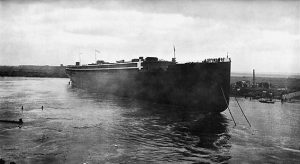 Once launched she was taken to the fitting out yard for completion. The main dining room on Kaiser Wilhelm II measured 108 feet by 69 feet, and rose through three floors to a skylight between the pairs of funnels. It even included two minstrels’ galleries. The smoking room was horseshoe-shaped around a funnel casing and also had the benefit of a large skylight. Further aft was a Vienna Café, which allowed both ladies and gentlemen to meet and mingle socially. For those ladies preferring to stay separate there was also a Ladies’ Salon.
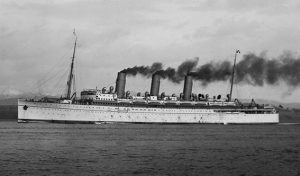 Canadian Pacific’s latest liner, Empress of Russia, sailed from Liverpool on 1st April 1913, heading for Vancouver via Gibraltar, Suez, Colombo, Singapore, Hong Kong, Shanghai, Nagasaki and Yokohama. She arrived at Vancouver on 7th June 1913, under Captain Beetham, after a brief stop and civic reception at Victoria. Thousands gathered to welcome her at the quayside.
 CPR had ordered two new vessels from Fairfield’s in 1911 – Empress of Russia (Yard No 484) and Empress of Asia (Yard No 485). They were 592 feet long, and 16,810grt. Both were equipped with turbines driving four propellers, giving a service speed of 19 knots and a maximum speed of 20.5 knots. Initial accommodation was listed as 284 in First Class, 100 in Second Class and 808 in Asiatic Steerage, with a crew of around 560.
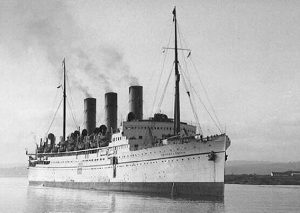 Both vessels were intended for the trans-Pacific service from Vancouver to Yokohama. Over the years they were to be extremely successful sisters, and were always popular with passengers. First Class in particular was very well-appointed.
 The first plates for the keel for Titanic were laid on the keel blocks on 31st March 1909, at Harland & Wolff’s Belfast yard. Built from the same blueprints as Olympic, it was anticipated initially that construction of the second vessel would be faster, based on the experience the workmen had gained from building Olympic. However, construction actually took several weeks more, overall.
 There were no problems with the workforce or weather at this time, and there were no pressures or diversions from other constructions within the yard. The logical conclusion therefore is that both White Star and Harland & Wolff were aware of financial shortfalls and construction was not given the same urgency as with Olympic. White Star had needed to get the first liner into service as soon as possible to earn revenue: they weren’t under the same pressure for Titanic.
 The extra time taken throughout Titanic‘s construction when compared to Olympic leads one to wonder about the outcome if she had been built faster and had made her maiden voyage weeks or even months earlier. No iceberg. No collision. No disaster. No loss of life. What effect would this have had on the twentieth century and on history in general!
 On 28th March 1922, Bismarck was towed out from the Blohm & Voss shipyard at Hamburg by two Belgian tugs. She was anchored overnight off Cuxhaven, and then preliminary trials were conducted. Bismarck had been allocated to Britain in late 1919 by the Allied Reparations Committee, after the Great War. In 1921 it was agreed that Cunard and White Star would jointly buy Imperator and Bismarck, but would retain separate ownership. Cunard paid £0.5 million and White Star paid £1 million for their respective vessels, each to be paid in ten instalments. Each line agreed to pay to the other one-half of the net profits of the ship it operated, using a pool system to share the profits.
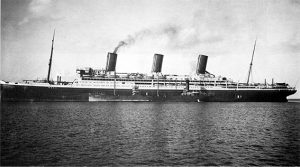 Finally, after taking on fuel, on 1st April 1922, still in her original Hapag livery and with “Bismarck” defiantly painted on her bows, she headed out into the North Sea, under Captain Hans Ruser, for her sea trials. There were several representatives of White Star aboard, including Captain Bertram Hayes, to study her performance. This was to be the only time she ever sailed under her German name in German colours with a German captain.
 On her return to Cuxhaven, the builders were given a final week to finish off work on the interiors. Once completed, on 9th April the German seamen and workers still aboard left on a harbour tender, and immediately after Captain Hayes and the British crew boarded. As soon as Captain Hayes had officially taken command, the British seamen quickly repainted the funnels in White Star colours, then painted out the name “Bismarck” on the bows and stern, replacing it with “Majestic”. Once in command, Bertram Hayes formally assumed the rank of Commodore of White Star’s fleet. Finally, the Red Ensign was hoisted, and later that day Majestic sailed for Southampton, watched in total silence by thousands of Germans, who lined the river banks.
 Author Les Streater will be on the Marpubs table during the BTS Convention sales day on 8th April at the Grand Harbour Hotel in Southampton, with copies of his book covering the complete history of White Star Line, including the ships and the management. He will also have copies of other books, including individual volumes on Majestic, Berengaria and Leviathan. Also the two books on Queen Mary, and a full history of Aquitania. Available on the table will be copies of his unique 5-volume set on the classic Art Deco French liner Normandie, available as a set or as individual books.
 All the books are brand-new, shrink-wrapped hardback books, A4 size. There are limited stocks of some titles. If you are attending and want a particular book from the Marpubs range, let us know and we will make sure a copy is reserved for you. Books can be signed if required.
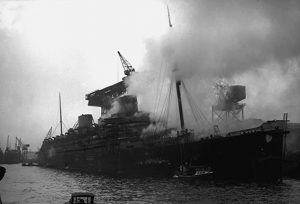 North German Lloyd used the intense public interest in its two new ships to its advantage, announcing that Bremen and Europa would sail on their maiden voyages only two weeks apart. Europa would depart on 24th April 1929, and Bremen would sail on 8th May 1929. However, a three month worker’s strike at Blohm & Voss meant it was increasingly doubtful that the shipyard could guarantee the projected date for Europa. Then, early on 25th March 1929, Europa was swept by fire that allegedly started at four different locations within the ship. Nearly eighteen hours later, at 9pm, the fire was finally brought under control.
 Initially, Europa was thought to be beyond repair, but after inspectors surveyed the damage more closely, they estimated repairs could be made for around $3,000,000. Her hull was declared sound, although the turbines and other propulsion machinery were heavily damaged. Unfortunately, in her partially-completed state, the shipyard had insured her for $9,500,000 in the event of a total loss, and not the $15,000,000 insurance value once completed. Before she could be rebuilt, Europa needed to be raised. During the fire, she had been flooded so she could settle in an upright position. Divers sealed every opening in the hull, and the water was pumped out. By 14th April 1929, the hull was afloat once again. Over the next few weeks, buckled plates were removed and the keel straightened. The turbines and heavy machinery were replaced or reconditioned. All the damaged interiors were removed and rebuilt.
 Amazingly, just ten months later, on 22nd February 1930, Europa was ready to leave for her sea trials. She left on her maiden voyage on 19th March 1930, heading for New York via Southampton and Cherbourg. Passing Ambrose lightship on 25th March, she had broken Bremen‘s record and gained the Blue Riband, taking 4 days 17 hours 6 minutes for the crossing.
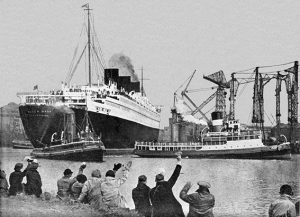 Finally Queen Mary was complete. Departure day was chosen as Tuesday, 24th March 1936, to take advantage of the high spring tide to help her down the Clyde. Minimum fuel was loaded, and only the two forward life-boats were fitted. Queen Mary was kept as light as possible, even though the channel had been dredged. Thousands of local people gathered, local shops closed, and schoolchildren were given the day off.
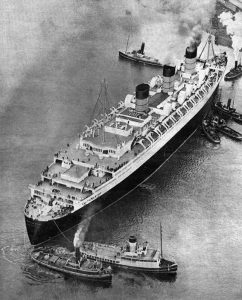 At 9.30am, Queen Mary gave four blasts on her siren. The Blue Peter was hoisted at the foremast, and at the main flew John Brown’s houseflag. Tugs moved in and at 9.45am began to ease the liner out from the basin. Five local ‘Flying’ tugs were used, plus Romsey, specially brought up from Southampton, and Paladin, from Anchor Line. Paladin and Flying Eagle took up forward positions, with Romsey and Flying Falcon aft. Flying Spray, Flying Kite and Flying Foam assisted alongside where needed.
 Jointly they pulled Queen Mary, stern first, into the Clyde, before swinging her head round to face seaward. Some twenty minutes of delicate manœuvring was needed. Two local Clyde pilots, Duncan Cameron and John Murchie, were in joint command. Queen Mary slowly headed down river, under her own power. The tugs stayed in close attendance, and were used primarily for guiding the liner through the narrow channel.
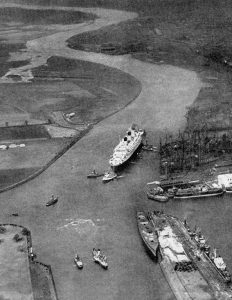 As she approached Dumbarton Bend near Dalmuir, Queen Mary was caught by the freshening wind and swung across the river. Her stern caught briefly on the South Bank, but the tugs quickly pulled her off. She briefly grounded a second time but again without damage. Both times were, however, sufficient to be listed at Lloyds. Travelling at between six and seven knots, it took Queen Mary about four hours to cover the fourteen miles to reach open water, off Gourock, arriving at 2.10pm.
 As she arrived she passed the burnt-out L’Atlantique, waiting to head upriver to the shipbreakers.
 On 23rd March 1943, Union Castle’s Windsor Castle was attacked and sunk some 110 nautical miles north-west of Algiers, while in Convoy KMF-11. This was a fast convoy of nine merchant vessels and 10 escorts, heading from the Clyde to Algiers. She was hit by an aerial torpedo around 2.30am, but did not sink until some 13 hours later. This gave the escorting vessels ample time to rescue the 2,699 troops and 289 crew aboard: only one crewman died in the attack. Subsequent descriptions stated that the troops lined up on deck almost as if on parade, and quietly waited for orders to enter their respective rafts or transfer to the escorting destroyers. There was no panic or confusion at all; the troops were subsequently taken to Algiers and landed, albeit without any of their kit or equipment.
 Originally ordered from Harland & Wolff, in Belfast, along with her sister, Arundel Castle, the order for Windsor Castle was transferred to John Brown’s yard on the Clyde, because of wartime shortages of materials. She was the last of the four-funnelled liners to be built. Launched on 9th March 1921, she was handed over in April 1922. In 1937 both Arundel Castle and Windsor Castle were rebuilt by Harland & Wolff: the forepart was lengthened and modernised, new turbines were installed and two fatter raked funnels replaced the four thin stovepipes. Both were popular ships on the run to South Africa.
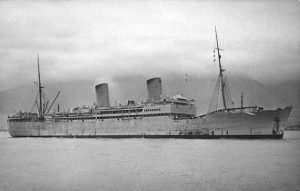 In 1939 both Windsor Castle and Arundel Castle were requisitioned for use as troop transports. They were painted in a simple plain grey camouflage scheme. After several successful convoys, including one in which a bomb hit her but failed to explode, her luck had run out.
 On 22nd March 1924, as Olympic was backing out from Pier 59 in New York, with 1,170 passengers aboard, she collided with Furness Withy’s Fort St George. The Furness ship had been heading down the Hudson, apparently in a race with Royal Mail’s Arcadian: both vessels were competitors on the service to Bermuda. The damage to the smaller vessel was quite extensive: the mainmast was snapped off and there was considerable damage to her decks, later estimated at £35,000. Passengers were transferred to Arcadian, which had also stopped at the scene.
 Initially it was thought that damage to Olympic was relatively slight, and after an hour at Quarantine while the steering mechanism was checked, she continued with her crossing. However it was later found that the cast steel stern frame had been broken and would need extensive and expensive repairs. On a later arrival at Southampton on 16th October 1925, Olympic was sent back to Belfast for an overhaul and refit, during which her stern frame was replaced, a major operation. The three castings needed were delivered in December and by early January had been fitted. The opportunity was also taken to weld repairs to hull cracks that had been found. Unfortunately the new stern frame was not successful, and in following years various efforts were made to reinforce it and to stop the corrosion that was occurring. In July 1927 a Federal Court attributed complete fault for the collision to Fort St George proceeding at high speed and not navigating far enough to the New Jersey shore, and then not porting soon enough when she saw Olympic.
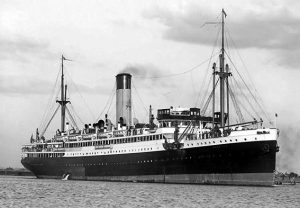 Fort St George had been built by Beardmore’s for Adelaide Steamship Co., as Wandilla, in 1912. After serving as a troop transport in the Great War, she was acquired by Furness Withy for the Bermuda service in 1921. In 1935 she was sold to Lloyd Triestino and renamed Cesarea, and in 1940 was requisitioned by the Italian navy and renamed Arno. She was sunk on 10th September 1942 by aerial torpedoes dropped by the RAF.