
On 16th April 1873, White Star’s Belgic left Liverpool for Valparaiso and Callao, on her maiden voyage. She had a full passenger list, and en route made calls at Pauillac, Lisbon and Montevideo. Built at Harland & Wolff, Belfast as Yard Number 81 for Bibby’s, she and her sister, Gaelic, were purchased by White Star while still on the stocks. As well as having a single propeller driven by a 2-cylinder compound engine, capable of 12 knots, she was barque-rigged with a full complement of sails. Launched on 17th January 1873, she was completed and handed over on 29th March that year.
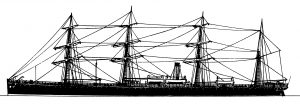 There are apparently no proven photographs of her, but there is a line drawing of her in Duncan Haws’ White Star book. Just over a year later, Belgic was transferred from the now-discontinued South American route, and on 30th May 1874 made her first voyage from Liverpool to New York. In April 1875 White Star confirmed that three of their ships – Belgic, Celtic and Oceanic – had been placed on long-term charter to the Occidental and Oriental Steamship Co. for a joint Pacific operation. They would remain in White Star livery but fly the Occidental housefly; they were to have White Star officers but a Chinese crew. Belgic left Liverpool on 8th May, heading for Hong Kong and Yokohama. In July 1883 Belgic was withdrawn from this service and returned to London, where she was sold to La Flecha of Bilbao and renamed Goefredo. Sadly she went aground in the Mersey on 26th February 1884, broke in two and was declared a total loss.
 Anchor Line’s
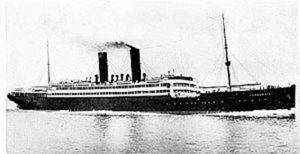 Cameronia was built by Henderson’s of Glasgow as yard number 472: she was a twin-propeller steamship, 515 feet long, 10,963grt. She was launched on 27th May 1911. Her maiden voyage from Glasgow to New York was on 13th September 1911. In February 1915 Cameronia was transferred to the joint Anchor-Cunard service from Glasgow to Liverpool and New York.
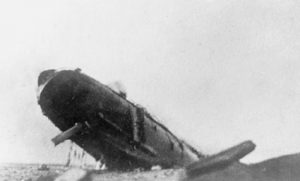 On 15th April 1917 Royal Mail’s Arcadian was en route from Salonika to Alexandria, then to the UK, with 1,335 troops and her crew, escorted by a single Japanese destroyer. Some 26 miles north east of the Greek island of Milos, she was hit by a torpedo from the German submarine UC-74. She sank within six minutes, with the loss of 279 lives.
 Arcadian had been taken up by the Admiralty in February 1915, and was quickly converted into an armed merchant cruiser. In April 1915 she was used by General Sir Ian Hamilton as his HQ during the opening phase of the Gallipoli campaign. Subsequently Arcadian was used as a troopship, primarily in the Mediterranean.
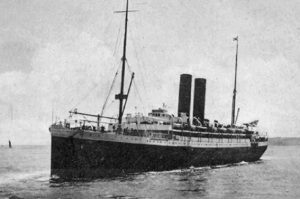 She had been built as Ortona at Vickers in Barrow, for Pacific Steam, and was launched on 10th July 1899 and completed on 26th October 1899. When built she could accommodate 140 passengers in First Class, 180 in Second and 300 in Third, and was used on the London to Australia route. In December 1902 she was used as a troopship during the Second Boer War. In May 1906 Ortona was sold to Royal Mail, still on the Australian service. In April 1909 she was transferred to Royal Mail’s West Indies service, then in 1910 was sent to Harland & Wolff in Belfast, where she was converted into a cruise ship, and renamed Arcadian. She left on her first world cruise in January 1912.
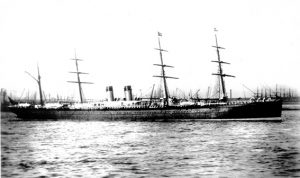 On 13th April 1877 White Star Line’s Germanic arrived at New York, having completed the crossing from Queenstown to Sandy Hook in 7 days 11 hours 37 minutes to set a new Blue Riband record. Her average speed over 2,830 miles was 15.76 knots. After a period in which the record had changed hands very frequently, this record was to stand for over 5 years, until Guion’s Alaska averaged 16.07 knots for a crossing on 16th April 1882.
 Germanic had been launched as Yard Number 85 at Harland & Wolff’s Belfast yard. Externally identical to Britannic, she was fitted with conventional engines and propeller and not the dropped shaft tried and discarded on her sister. Handed over on 24th April 1874, she made her maiden crossing from Liverpool to New York on 20th May 1874. In July of that year she gained her first eastbound record and on 7th August 1874 gained her first westbound record. Over the following years she was rebuilt several times and changed owners. By 1950 she was being used as a floating hotel in Turkey, as Gulcemal, and was finally broken up later that year. Over 76 years of service – a tribute to the builders!
 On 6th April 1941 Queen Mary and Queen Elizabeth met at sea for the first time, off Sydney Heads, Australia. Although they had been together briefly docked in New York, this was their first meeting at sea. Three other large liners joined them, together with an escort of cruisers and destroyers, to prepare for a major troop convoy.
 Soon after, they sailed in Convoy US10 with Mauretania, Île de France and Nieuw Amsterdam. They headed for Fremantle, where they topped up fuel and water tanks on 16th April, and reaching Trincomalee by 25th April. Queen Mary had 5,724 Australian troops, Queen Elizabeth had 5,633, Île de France had 3,269, Nieuw Amsterdam had 2,642 and Mauretania had 3,891 New Zealanders. They reached Port Suez safely on 6th May.
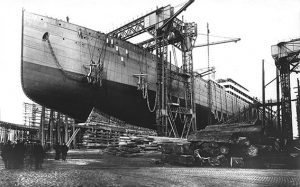 Celtic (yard number 335) was launched at Harland & Wolff on 4th April 1901. She was the first ship to exceed Great Eastern’s gross tonnage and the last ship to be ordered from Harland & Wolff by T.H. Ismay. She was the first of the group that was to become known as the “Big Four”. These were designed primarily as passenger liners, with the carriage of cargo a secondary matter, even though she could carry 17,000 tons! Celtic had two quadruple-expansion engines with eight double-ended boilers working at 210psi. When built she was designed to carry 347 passengers in First Class, 160 in Second and 2,350 in Third.
 Celtic was handed over by Harland & Wolff on 11th July 1901. After completing her trials, she arrived in the Mersey. Under Captain Henry St George Lindsay, she began her maiden voyage, from Liverpool to New York, on 26th July. She arrived in New York on 4th August, taking 8 days 46 minutes for the crossing. J. Bruce Ismay missed the maiden voyage for business reasons but was aboard for the second voyage.
 On 3rd April 1913, Hapag’s Vaterland was launched by Prince Rupprecht of Bavaria. Initially Ballin had wanted to call the liner Europa, but political pressure from the Emperor forced him to change this just before the launch. The three liners in this group – Imperator, Vaterland and Bismarck – were not strictly sisters, with variations in length, breadth and gross tonnage, and interior differences. However they shared a common profile and were generally regarded as sisters.
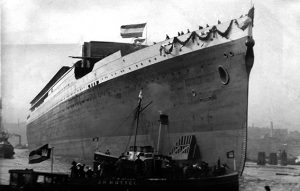 Once the speeches were made, the Prince released the traditional bottle of champagne and the hull slid slowly into the River Elbe. Three tugs moved in and towed her to the fitting-out berth. Meanwhile the principal guests enjoyed a festive dinner held at Hamburg’s City Hall. Sadly she had a very brief career as Vaterland, and was interned at New York at the outbreak of the Great War. Later she was seized by the US authorities and renamed Leviathan, becoming America’s first superliner.
 On the 3rd April 1934, after 27 months of enforced idleness, the first of the shipyard workers, some 400 men, returned to the yard, at 7.00am, escorted by pipers from the Dalmuir Parish Pipe Band in full regalia. The first thing they had to do was clean off rust – around 130 tons of it – and birds’ nests and bird droppings from the hull of liner 534 – later better known as Queen Mary. Lloyd’s surveyors inspected the structure, and reported that overall the state of the steelwork was quite remarkable. The other major concern was whether or not the hull had suffered any distortion from sitting on the stocks for so long. To everyone’s relief, the construction had been sufficiently thorough to support the hull throughout the period of enforced idleness and she passed a Lloyd’s inspection. On 26th May 1934, official permission was received from the Government to resume construction. Soon thousands of men were back at work, in the yard and the many outside suppliers.
 Work had been suspended on 11th December 1931, when Cunard ran out of money, at the height of the Great Depression. Apart from a few men retained for essential maintenance, thousands were laid off, along with several thousand more at the various suppliers of components and parts. Finally in October 1932 the Chancellor of the Exchequer, Neville Chamberlain, asked Lord Weir to look into the problem and make recommendations. As a result, Cunard and White Star merged, in return for which the UK government agreed to provide financial assistance for the completion of Hull 534 – later Queen Mary – with enough for a later sister ship. The North Atlantic Shipping (Advances) Bill was approved in the Houses of Parliament on 27th March 1934, and signalled the start of the end of the Depression.
 At 8.00pm on 2nd April 1912 Titanic raised her anchors and prepared to leave Belfast. She headed down the Lough and into the Irish Sea. From there she headed into St George’s Channel, past the north Cornish coast, round Land’s End and into the English Channel. As dusk fell she approached the Isle of Wight, then into Spithead. During the trip, Captain Smith took the opportunity to conduct several more tests.
 She stopped at the Nab lightship around 10.00pm to collect the local pilot then rounded the Brambles sandbanks into Southampton Water, and headed for Southampton. She was met by five Red Funnel tugs – Ajax, Hector, Hercules, Neptune and Vulcan – to assist her through the channel and into Berth 44 at the White Star Dock. Arriving at high tide, around 11.30pm on 3rd April 1912 the tugs turned her so that she faced downstream, then eased her in towards Berth 44. She was warped in and by just after midnight on 4th April 1912 she was secured at her dock. Earlier Olympic had beeen docked at Berth 44. She sailed on her tenth crossing at noon on 3rd April, leaving the berth vacant and ready for her sister.
 White Star’s Majestic, under Captain Parsell, sailed on her maiden crossing from Liverpool on 2nd April 1890. After stopping at Queenstown on 3rd April, she arrived in New York on 10th April, taking 6 days 10 hours west then 6 days 8 hours 58 minutes east, the best maiden voyage to that date.
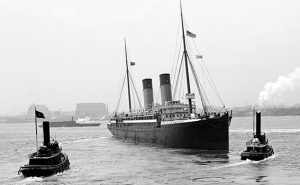 Majestic (yard number 209) had been launched at Harland & Wolff on 29th June 1889, and was delivered on 22nd March 1890. She had two triple-expansion engines, each in a separate engine-room, driving twin propellers. There were twelve double-ended and four single-ended boilers, supplying steam at 180psi. The masts did not have yards, and no sails were ever carried. Accommodation was initially listed as 300 First Class, 170 Second Class and 850 Third Class.