 Early in January 1937 there were rumours that Leviathan, laid up since September 1934, was to be converted into a troopship, but neither the US Army or Navy were seriously interested. In October 1937 formal calls were made for bids from scrapyards, although some rather onerous conditions were included. Only two bids were submitted: the winning bid of $800,000 was made by two British companies, Ward’s and Metal Industries. They planned to scrap her at Rosyth in Scotland, an area of high unemployment, to provide work for up to 400 men. The final amount paid was $732,000, well below the $2.5 million US Lines had expected.
On 13th December 1937 workers from Bethlehem Steel came aboard to prepare the engines, boilers and other machinery for her final trip, to be made under her own power. On 17th December 1,500 tons of fuel oil was pumped aboard. The skeleton crew from US Lines left on 28th December, and the US flag was finally lowered. A UK firm had hired a crew of 150 to handle Leviathan on the trip to Rosyth, and they sailed for New York aboard Berengaria. Captain John W. Binks was brought out of retirement for the crossing: he had previously commanded both Majestic and Olympic, and was used to handling such big vessels.
 On 10th January 1938 the funnels were shortened by 10 feet and the masts by 30 feet, so she could pass under the Forth Bridge. Lifeboats were taken down, furniture was roped together and carpets rolled up. The initial plan was for Leviathan to sail on 21st January, to arrive at Rosyth on 3rd February. The engines and boilers were tested and approved, but then the British seamen went on strike when they realised some American sailors on board were receiving a higher level of pay! Captain Binks arrived on board on 19th January, with three supporting officers, but with the strike, they weren’t able to sail. Sailing was delayed several times as the strikers demanded wage parity, then a bonus, but finally a settlement was reached. On 25th January the tugs arrived to assist Leviathan from her berth; later that day more fuel was loaded, and final preparations made. Eventually, on 26th January she left New York, sailing under the Red Ensign rather than the US flag, under a huge cloud of black smoke.
 After 3,164 miles, at an average 17.1 knots, Leviathan arrived off Scotland on 3rd February, but missed the spring tide and had to wait nine days for the next. On her first attempt to enter the Firth of Forth, she grounded in a strong gale, and had to be towed off. On 14th February another attempt was made, and she finally made it into the Admiralty Basin, opposite her sister, HMS Caledonia (ex-Majestic).
 Scrapping did not proceed very quickly, and finally in August 1939 the Admiralty ordered Metal Industries to clear the yard: with the deteriorating situation in Europe they realised they would soon be needing the facilities. The remains were towed out of the basin and beached. Scrapping was not complete until 14th February 1940.

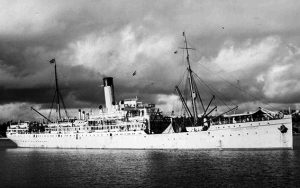 Union Castle’s Durham Castle was completed in February 1904 at Fairfield’s Govan yard, She was built for the Union Castle East Africa service from Cape Town to Mombasa, and was 475 feet long, 8,240grt. During the Great War she primarily remained on her commercial service, occasionally being used as a troopship. She was popular and regular vessel, and was finally withdrawn from service in 1939. Union Castle put her up for disposal, having replaced her with Pretoria Castle. She was purchased in August 1939 by Metal Industries for scrapping at Rosyth.
 After the outbreak of World War II, on 2nd October she was acquired by the Admiralty for use as an accommodation ship at Scapa Flow. Some other reports say she was to be used as a store ship or even as a blockship. On 26th January 1940 she was being towed by HMS Watermeyer to Scapa Flow when she hit a mine off Cromarty and sank. The weather was atrocious, with a gale blowing and icy conditions. There were no casualties. The mine was probably laid by the German submarine U57, under Captain Claus Korth.
 Canadian Pacific’s Empress of Canada had arrived at Liverpool on 10th January 1953 for her annual refit. Once complete, on 24th January she was moved from the drydock to Gladstone Dock. She was already well-booked for the coming season, as it was the Coronation Year in the UK. The next day, 25th January, there were around 250 workers aboard completing the final cleaning, plus a skeleton crew.
 That afternoon fire broke out on B Deck, and quickly spread. The fire was so intense 18 pumps were called in as well as a fire and salvage tug. Eventually there were over 40 units and 200 firemen on site. Firefighters had to wear breathing apparatus. At 10.00pm the order was given to abandon ship, and the firemen were ordered to concentrate on protecting the adjacent warehouses.
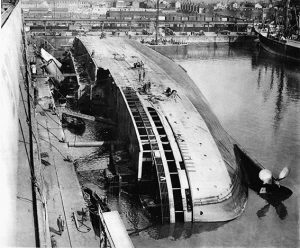 Early the next morning Empress of Canada capsized. She was soon declared a total loss, and salvage operations began. After removing all top hamper and sealing any openings, on 6th March 1954 she was rolled upright and then raised. On 14th September the remains were sold for scrapping at La Spezia, but the tow proved extremely difficult and she didn’t arrive until 10th October 1954, where she was finally demolished.
 En route from Liverpool to Halifax, on 25th January 1917 White Star’s Laurentic hit two mines that had been laid by German submarine U80 in Lough Swilly. She had 479 passengers aboard, mainly naval personnel, and £5 million in gold bullion, to be used to purchase war munitions. All told, 354 aboard died, many dying of exposure in their lifeboats in the freezing weather that night.
 Laurentic had been launched at Harland & Wolff, Belfast, on 9th September 1907, and could carry 230 in First, 430 in Second and 1,000 in Third, plus a large refrigerated cargo. She had a combination of two reciprocating engines and a low-pressure turbine, and was a test bed alongside her sister, Megantic, for the system to be installed in the Olympic Class. She had been requisitioned as a troopship on 13th September 1914.
 After the regular annual refit during December 1933, on 3rd January 1934 Aquitania returned to service. On her second departure from Southampton, on 24th January 1934 Aquitania ran aground off Calshot Spit in the Solent. The tide was still rising, and with the aid of several local tugs she was soon pulled free, and was able to resume her crossing.
 After her next annual refit, Aquitania resumed the trans-Atlantic run on 23rd January 1935. On 31st January she left New York for another Mediterranean cruise, which was repeated on 9th March. In April 1935, entering the Solent during a 60mph gale as she returned from her second cruise, she grounded again, this time on the Brambles mudbank, Thorne Knoll, in Southampton Water. With the tide already dropping, it was decided to take passengers off by tender, and gallons of fuel oil was pumped out to tenders brought alongside, in an attempt to lighten her. Although she was undamaged, it took a whole day – and eleven tugs – to successfully pull her off.
 On 23rd January 1920, Mount Vernon (ex-Kronprinzessin Cecilie) sailed from San Francisco for Vladivostok, via the Panama Canal, to collect 4,000 refugees, mainly Czechoslovakian troops, escaping from the civil war still raging in Russia. Some 7,000 tons of coal were loaded for the trip to Siberia. On arrival, 261 First Class passengers and 3,074 escaping troops were taken aboard, and she sailed on 13th April. Stopping at San Francisco, she collected a further 700 prisoners of war, and on 12th June arrived at Norfolk, where all the passengers were debarked.
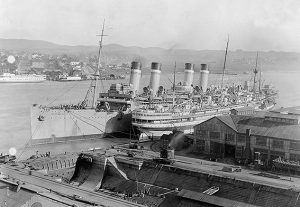 Mount Vernon then returned to Mare Island in California, where she was laid up. Following the outbreak of the Great War, the German express liner Kronprinzessin Cecilie had been seized by US authorities on 6th April 1917 and allocated to the US Navy. She was converted into a troopship, to accommodate 3,000 troops, and six 5-inch guns were mounted for defensive purposes. She was commissioned on 28th July 1917 as USS Mount Vernon, ID-4508, and after her trials and a shake-down cruise, on 13th October she joined the New York Division of the Atlantic Fleet Cruiser and Transport Force. After sterling service in 1917 and 1918, she was decommissioned on 29th September 1919. Later laid up in Chesapeake Bay, she was eventually scrapped Baltimore in September 1940.
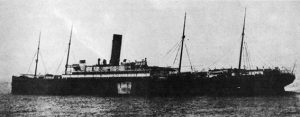 Following the major earthquake that had devastated Messina in Italy on 28th December 1908, White Star announced that it would carry, free of charge, any freight addressed to the Italian Red Cross Society for the relief of the victims. Republic arrived at New York on 13th January 1909, loaded emergency supplies for Messina, and sailed on 22nd January. Her accommodation was fully booked, and she was carrying 560 tons of supplies: these were to be transferred to the the US Navy supply ship Culgoa at Gibraltar. There were also unsubstantiated rumours that she had a large amount of gold and silver aboard for the relief fund and also for the payroll for the US Atlantic Fleet based at Gibraltar.
 The next day, 23rd January, travelling in dense fog off Nantucket, she was rammed by Lloyd Italiano’s Florida. Severe damage was done to Florida‘s bow, and a large hole was ripped in the side of Republic. Jack Binns, later of Titanic fame, was the radio operator aboard, and he managed to summon several rescue vessels, including White Star’s Baltic. Apparently this was the first time a CQD distress call had been sent.
 Republic‘s passengers were safely transferred to Baltic, and Florida was safely escorted to New York and was later repaired. However the damage to Republic was too severe, and in spite of attempts to tow her back to New York, she sank at 8pm the next day. White Star later sued Lloyd Italiano for $2 million in damages, but the Italian company had filed a limitation of liability action and later obtained a court order staying all damage suits against it. A Captain Bayerle has established salvage rights to the wreck and plans to try to recover any bullion or other valuable material in the near future.
 Holland America’s ship will be built at Fincantieri at Marghera, with delivery scheduled for 2021. This will be the third vessel in the Pinnacle Class, and will be based on the design of Koningsdam and Nieuw Amsterdam. Each will accommodate 2,660 passengers.
 The Princess Cruises’ ship will be built at Fincantieri at Monfalcone, with delivery scheduled for 2022. It will be based on the Royal Class, and will accommodate 3,660 passengers.
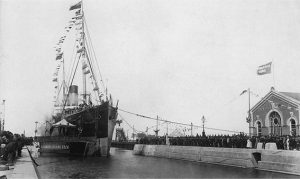 On 19th January 1889, White Star’s Teutonic was launched at Harland & Wolff, Belfast. With her sister, Majestic, they were the first twin propeller vessels for White Star; although they still had masts, they were not rigged for sails. They were designed for fast conversion into armed merchant cruisers (AMC). Accommodation initially was 300 in First Class, 190 in Second Class and 1,000 in Third Class. On 21st May 1889 the Prince of Wales came aboard Teutonic for an inspection, and then watched as she entered the brand new Alexandra Graving Dock, which had been named after his wife.
 Delivered on 25th July 1889, Teutonic arrived at Liverpool on 29th July, where she was quickly converted into an AMC and took part in Queen Victoria’s Golden Jubilee Fleet Review at Spithead. Back in her peacetime guise, she sailed on her maiden voyage to New York on 7th August. In June 1897 she was present as an AMC at the Diamond Jubilee Naval Review, notable for the appearance of Charles Parsons’ Turbinia. In May 1907 she made her last sailing from Liverpool, and was then transferred to the new Southampton express service. A notable crossing was in November 1907, when she arrived in New York with $1.6 million in gold aboard.
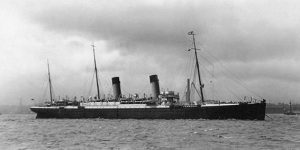 In April 1911 she was transferred to the White Star/Dominion service from Liverpool to to Canada, and was sent to Belfast for conversion to cope with the colder conditions on the route. Plating was added to the upper and promenade decks, and a larger bridge was fitted. Accommodation was now 550 in Second Class and 1,000 in Third Class.
 With the outbreak of the Great War, in September 1914 Teutonic was requisitioned as an AMC and joined the 10th Cruiser Squadron, operating in the northern approaches. She was purchased outright by the Admiralty in September 1915 and adapted for use as a troopship. In December 1916 she was placed in reserve and laid up, but was recommissioned in October 1917 as an AMC. In December 1918 she reverted to being a troopship carrying troops to Egypt. Early 1921 Teutonic was laid up again and offered for sale. With no purchasers, in August 1921 she was sold and scrapped in Emden, Germany.
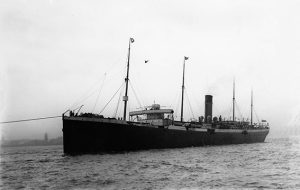 On 18th January 1908, White Star’s Suevic returned to commercial service after rebuilding following grounding on 17th March 1907. She had been built at Harland & Wolff, Belfast, and was launched on 8th December 1900. A twin-propeller steamship, she was designed for the Australian service, with refrigerated capacity for 100,000 carcasses of mutton, plus 20,000 bales of wool. She was requisitioned in 1900 for use as a troopship during the Boer War.
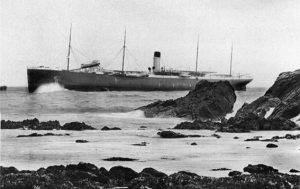 Once released, she settled into her regular commercial service. On 2nd February 1907 she sailed from Melbourne for Liverpool, with planned stops at Cape Town, Tenerife and Plymouth, before arriving at London. Leaving Tenerife on 13th March, by 17th March she was approaching The Lizard, sailing in thick fog, but was off-course, and ran onto Maenheere Rocks. Suevic‘s own boats and two lifeboats rescued the passengers. A specialist salvage team was sent out, and passengers’ luggage was saved, and most of the wool and grain aboard was removed.
 Suevic was hard aground, and eventually the decision was taken to use a series of 30 small charges of dynamite to separate the damaged bows from the rest of the vessel. The operation was successful, and the stern section was towed to Southampton.
 In the meantime, a new bow section was built from the original plans, at Belfast, and then towed stern-first to Southampton. On 4th November 1907 the two sections were joined up successfully. The rebuilt ship left Southampton on 8th January 1908. Her later service included transporting Australian and New Zealand troops during the Great War. In 1928 she was sold to Norway and converted into a whale factory ship, Skytteren. On 1st April 1942, while attempting to escape the Nazis, she was scuttled.