
 White Star’s Britannic, Captain Thompson, gained the westbound record for crossing the Atlantic on 24th December 1876. She crossed from Sandy Hook to Queenstown, 2,882 nautical miles, in 7 days 12 hours 41 minutes. Having already gained the westbound record on 4th November, she was the only White Star vessel to hold both records at the same time.
Britannic was built at Harland & Wolff in Belfast, yard number 83, as were almost all White Star’s vessels. She was White Star’s first two-funnelled steamer, and was originally still rigged as a four-masted barque to carry sails. Laid down as Hellenic, she was launched on 3rd February 1874, and made her maiden voyage from Liverpool to New York via Queenstown on 25th June 1874. She was unusual in that she was built with the propeller only slightly above the keel, and the engines were tilted slightly aft to keep the shaft inline. A universal joint in the propeller shaft meant the propeller could be raised when in shallow water and lowered for greater thrust when in deeper water. The idea was not successful and she was quickly sent back to Belfast for a more traditional arrangement. At this time the square-rigged masts were removed and pole masts fitted. The next sailing in her new rig left Liverpool on 8th June 1876.
 In August 1877 Britannic broke the westbound record again, taking 7 days 10 hours 53 minutes from Queenstown to Sandy Hook.
Always a popular ship, Britannic enjoyed good passenger numbers. Generally she had a good safety record. On 31st March 1881 she sank an Irish schooner, Julia, but the crew was saved. In July 1881 she went aground off Kilmore in Ireland in heavy fog, but was quickly refloated and repaired. She suffered a minor collision with White Star’s Celtic in May 1887, when both vessels were slightly damaged. Both captains were later censured for excessive speed in dense fog. In August 1899 she was declared surplus to needs and was to be sold for scrap. Instead she was requisitioned by the British government and used as a troop transport during the Boer War in South Africa. She made 11 round voyages, including two trips collecting troops from New Zealand and Australia. She was finally scrapped at Hamburg in August 1903.
CLICK HERE TO RETURN TO OVERVIEW PAGE
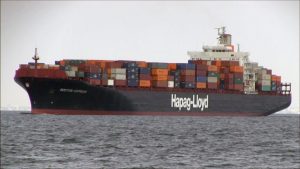 Recently Hapag-Lloyd’s container ship Bremen Express was forced to stop while eastbound in the Atlantic for undisclosed emergency repairs. While these were being carried out, the ship started rolling, and a number of containers were lost overboard. At the time the vessel was some 1,400 nautical miles off the west coast of Europe. Hapag-Lloyd stated the vessel was not in any danger at the time, and it later continued its journey. It will be inspected once it arrives in the Mediterranean before being allowed to enter the Suez Canal as it heads for Asia. The authorities are said to be conducting an investigation into the incident.
 In an unrelated incident but highlighting the dangers of lost containers, a French sailor, Thomas Ruyant, taking part in the Vendée Round the World yacht race, had to make a distress call. His boat had collided with a floating shipping container while a few hundred miles south of New Zealand. The captain of the yacht reported that his vessel was in danger of splitting in two, after hitting the container while travelling at about 17 knots. Later reports stated that the New Zealand Coast Guard had delivered a pump to the yacht, and the skipper was hoping to make port.
 The Seoul Central District Court has announced that Hanjin, South Korea’s largest shipping line, has recently signed a provisional contract with Swiss-based MSC. This will allow the company to sell off its stake in the Long Beach container terminal in California.