Thomas H. Ismay was born on 7th January 1837 at Maryport in Cumberland, where his father, Joseph, was a successful local shipbuilder. He attended the local school until 12, then Croft House, a boarding school near Carlisle. He entered a three-year apprenticeship with Imrie, Tomlinson in Liverpool: another apprentice was William Imrie, and they quickly formed a close friendship. At the end of his apprenticeship, in 1856 he signed up to sail on the barque Charles Jackson, heading for Valparaiso, Chile via Cape Horn; he returned in October. T.H. Ismay went back to working with Imrie Tomlinson, where he met Philip Nelson, a ship-owner.
 In 1858, when T.H. Ismay reached 21, he and Philip Nelson set up business as shipbrokers, trading as Nelson, Ismay & Co. T.H. Ismay married Margaret Bruce in Liverpool on 7th April 1859. Nelson, Ismay ordered their first ship, from Alexander Stephen on the Clyde in 1858, and in the following years purchased several more vessels. On 1st April 1862 Philip Nelson retired and the firm was dissolved. Ismay continued with ship and insurance brokering, as T.H. Ismay & Co.
The shipping company Wilson & Cunningham went into liquidation on 18th January 1868. Its trading name, White Star, its house flag of a red burgee with a white star, and goodwill, were sold to Thomas H. Ismay and George H. Fletcher for £1,000.
 Gustav Schwabe introduced Ismay to Gustav Wolff, his nephew, and Edward Harland, who were building steamships at Belfast. Schwabe proposed to Ismay that, if he had all his vessels built at the Belfast yard, he would back Ismay in establishing a new shipping company. On 30th July 1868 T.H. Ismay’s White Star Line and Harland & Wolff finalised an agreement to build three steamers. Soon after Oceanic Steam Navigation Co. Ltd was formally registered on 6th September 1868, with an initial issue of 400 shares of £1,000 each. The new company was to concentrate on the north Atlantic.
William Imrie Senior died in 1870 and his son, also William, combined the business with T.H. Ismay, known as Ismay, Imrie & Co. T.H. Ismay would manage steamers on the north Atlantic as White Star Line, while William Imrie would manage sailing vessels, mainly to Australia. White Star now started to grow and develop.
 After several successful years, on 21st December 1891 T.H. Ismay resigned from Ismay, Imrie, with his sons Bruce and James joining the board; he remained as chairman. Ismay was summoned to the Foreign Office on 16th June 1897 and was informed that Queen Victoria wished to confer a baronetcy on him. However, the honour was declined.
While on a short holiday in early 1899, T.H. Ismay collapsed. Diagnoses varied, including liver complaint and lower bowel. The attacks continued for several months, getting progressively more severe, although in July he was well enough to visit Belfast to tour Oceanic. While there he was presented with the freedom of the city.
On 28th August 1899 he suffered a major relapse. A surgeon operated on the gall bladder on 31st August, with a second operation on 4th September. T.H. Ismay’s health continued to deteriorate, and on 13th September he suffered the first of several heart attacks. T.H. Ismay died at just 62, on 23rd November 1899, and was buried on 27th November.

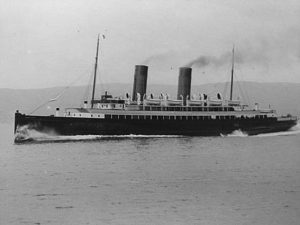 Ben-My-Chree (Manx language meaning “Girl of my Heart”) was a packet turbine steamer between Liverpool and Douglas on the Isle of Man. She was built by Vickers in 1907, She was 390 feet long, with five decks, and could carry 2,549 passengers, entering service in August 1908.
 She was chartered by the Royal Navy in January 1915, and was sent to Cammell Laird at Birkenhead where she was converted into a seaplane carrier. A large hangar was built aft, that could house between four and six seaplanes. Derricks were used to lift the aircraft in and out of the water. Initially there was a 60-foot dismountable take-off platform installed forward of the superstructure but this was soon removed..
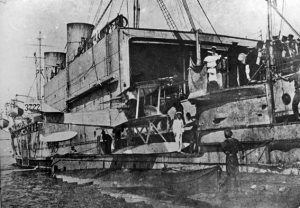 Once converted, she was initially assigned to the Harwich force, and took part in two abortive raids on Norddeich. Following this, she sailed for the Dardanelles, with two Short 184 torpedo bombers. She was at Lesbos by June 1915. Over the following months the seaplanes were mainly used as spotters for the naval artillery supporting the troops ashore, and also the occasional torpedo attack.
 On 20th December 1916 Ben-My-Chree was sent to the Greek island of Kastellorizo to support French troops fighting the Turks. The Turkish battery opened fire on the steamer, disabling her steering and starting a fire that quickly spread. The crew abandoned ship, and the Turks continued firing until the steamer sank in fairly shallow water. The wreck was refloated in 1920 and towed to Piraeus. After survey it was declared a constructive total loss and was eventually broken up in Venice in 1923.
 In 1881 two new ships were ordered from Harland & Wolff: these were to be Ionic and Doric, designed and built for the immigrant service to New Zealand. Ionic (yard number 152) was launched on 10th January 1883, as a 4-masted barque-rigged freighter, with accommodation for 70 passengers, and the first engines built by Harland & Wolff for White Star, as four-cylinder compounds.
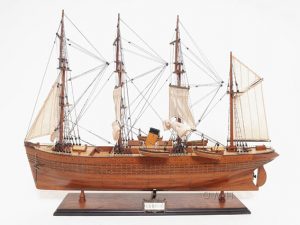 Gaelic left Liverpool on her maiden voyage on 29th January 1873, bound for Valparaiso, Chile, with calls at Pauillac, Vigo and Lisbon to embark passengers and cargo. She made the first of eight north Atlantic crossings on 10th July 1873 from Liverpool, and arrived in New York on 22nd July. In 1874 Gaelic was switched from Liverpool to London and made the first of four round-trip sailings on 3rd June. She later reverted to the Liverpool route.
 1918: Spenser. Built 1910 by Armstrong, Whitworth. Owner Lamport & Holt, 4,186 tons. En route from Buenos Aires to Liverpool with general cargo. Attacked and sunk by German submarine U-61, Captain Dieckmann, St George’s Channel. No casualties.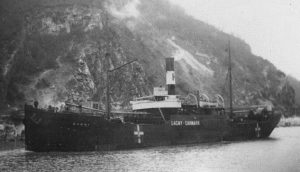
 1918: War Baron. Built 1917 by North West Steel, Portland, Oregon. Operated by The Shipping Controller, 6,240grt. En route from Southampton to Barry in ballast, was sunk by the German submarine U-55, Wilhelm Werner, 8 miles north-east of the Godrevy lighthouse, St Ives. 2 persons were lost.
 White Star’s Delphic was launched at Harland & Wolff, Belfast on 5th January 1897. She was jointly owned by White Star and Shaw, Savill & Albion for their service to New Zealand. She was a steel-hulled steamer with twin propellers, one funnel and four masts. She was designed to carry refrigerated meat in three forward holds and could also carry 1,000 emigrants. Originally she carried yards on the foremast plus three jibs and a two trysails. Delivered on 15th May 1897, she left on her maiden voyage to New York on 17th June, under Captain Sowden. After a second Atlantic crossing in July, she was placed on the New Zealand service.
 On 30th September 1897 she left on her maiden voyage for Wellington, arriving on 21st November. After visiting several ports in New Zealand, she was back in London on 27th February 1898. She then settled into a regular service. Delphic also made two trooping runs to South Africa during the Boer War.
 1918: Rewa. Owned by British India. Built 1906 by Dennys. She was on Government service as Hospital Ship No. 5, and clearly marked as such. Torpedoed and sunk in the Bristol Channel by the German submarine U55, Captain Wilhelm Werner. Carrying 279 wounded officers and men from Mudros to Avonmouth. 4 lost.
 1918: Iolanthe. Owned by London American Trading. Built 1904 by Grays of Sunderland, she was 3,081grt, 325 feet. Torpedoed in the English Channel, off Portland Bill, by German submarine UC75, Captain Lohs. Abandoned and later sank.
 1943: British Vigilance. Built in 1942 by Harland & Wolff, Govan, she was 463 feet long, 8,093grt. On 3rd January 1943 she was in Convoy TM-1 from Curacao to Gibraltar carrying petrol when she was attacked by German submarine U514 about 900 miles north-east of Barbados. Abandoned by the crew, she burnt and drifted until she was finally torpedoed and sunk by U105 on 24th January 1943. 25 crew and 2 gunners lost.
 Belgic (Yard No 171) was launched at Harland & Wolff on 3rd January 1885, for the joint White Star/Occidental & Oriental service. She had two double-cylindered engines of 500 hp, which were two distinct and complete units capable of being disconnected, and worked separately. She was handed over to White Star on 7th July 1885, and arrived in London on 14th July. Originally the fore and main masts were rigged for sails.
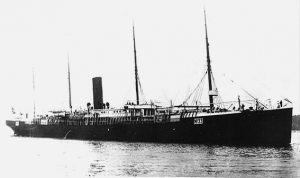 On 28th January 1886 Belgic suffered a broken piston rod and was delayed eight days at Yokohama for repairs. At Amoy, China, on 26th May 1894, Belgic was struck amidships by Blue Funnel’s Ulysses. The damage was above the waterline and she sailed the next day, arriving at San Francisco on 18th June. On 8th September 1895 Belgic went ashore in Sateyama Bay in Japan. Refloated on 10th October 1895 she sailed to Yokosuka for temporary repairs. She returned to Hong Kong, arriving on 4th November, and remained there until January while repairs were completed.