
1917: Beaufront. Built 1915 by Dobson, Newcastle. Owner J Ridley & Son, 1,720 tons. En route from Bilbao to Tees with cargo of iron ore. Torpedoed and sunk off Finistere by German submarine U-82. No casualties.
1917: Ville du Havre. Built 1904 by Atel. et Chant. de France. Owner Cie Havraise Peninsular. French cargo ship, attacked and sunk north west of Cape Villano by German submarine U-48.
 1918: Spenser. Built 1910 by Armstrong, Whitworth. Owner Lamport & Holt, 4,186 tons. En route from Buenos Aires to Liverpool with general cargo. Attacked and sunk by German submarine U-61, Captain Dieckmann, St George’s Channel. No casualties.
1918: Halberdier. Built 1915 by Ropners. Owner Fisher, Renwick, 1,049 tons. En route from Manchester to London with a general cargo. Attacked and sunk by U-61, Captain Dieckmann, St George’s Channel. 5 lost.
1918: Gascony. Built 1908 by Craggs, Middlesborough. Owner David MacIver, 3,133 tons. Attacked and sunk by UC-75, Captain Lohs, 10 miles SSE of Owers light vessel. No casualties.
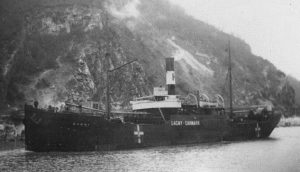
1918: Dagny. Built 1901 by W Gray, Hartlepool. Owner Dampsk. Heimdal, 1,220 tons. En route from Port Talbot to Bordeaux with a cargo of coal. Danish vessel, torpedoed and sunk in the Bay of Biscay by German submarine U-93, Captain Gerlach. 2 lost.
1918: Harry Luckenbach. Built 1881, W Gray, Hartlepool. Owner Luckenbach,2,798 tons. En route from Penarth. An American tanker, attacked and sunk in the Bay of Biscay by German submarine U-93, Captain Gerlach. 8 casualties.
 1918: War Baron. Built 1917 by North West Steel, Portland, Oregon. Operated by The Shipping Controller, 6,240grt. En route from Southampton to Barry in ballast, was sunk by the German submarine U-55, Wilhelm Werner, 8 miles north-east of the Godrevy lighthouse, St Ives. 2 persons were lost.
 White Star’s Delphic was launched at Harland & Wolff, Belfast on 5th January 1897. She was jointly owned by White Star and Shaw, Savill & Albion for their service to New Zealand. She was a steel-hulled steamer with twin propellers, one funnel and four masts. She was designed to carry refrigerated meat in three forward holds and could also carry 1,000 emigrants. Originally she carried yards on the foremast plus three jibs and a two trysails. Delivered on 15th May 1897, she left on her maiden voyage to New York on 17th June, under Captain Sowden. After a second Atlantic crossing in July, she was placed on the New Zealand service.
 On 30th September 1897 she left on her maiden voyage for Wellington, arriving on 21st November. After visiting several ports in New Zealand, she was back in London on 27th February 1898. She then settled into a regular service. Delphic also made two trooping runs to South Africa during the Boer War.
 1918: Rewa. Owned by British India. Built 1906 by Dennys. She was on Government service as Hospital Ship No. 5, and clearly marked as such. Torpedoed and sunk in the Bristol Channel by the German submarine U55, Captain Wilhelm Werner. Carrying 279 wounded officers and men from Mudros to Avonmouth. 4 lost.
 1918: Iolanthe. Owned by London American Trading. Built 1904 by Grays of Sunderland, she was 3,081grt, 325 feet. Torpedoed in the English Channel, off Portland Bill, by German submarine UC75, Captain Lohs. Abandoned and later sank.
 1943: British Vigilance. Built in 1942 by Harland & Wolff, Govan, she was 463 feet long, 8,093grt. On 3rd January 1943 she was in Convoy TM-1 from Curacao to Gibraltar carrying petrol when she was attacked by German submarine U514 about 900 miles north-east of Barbados. Abandoned by the crew, she burnt and drifted until she was finally torpedoed and sunk by U105 on 24th January 1943. 25 crew and 2 gunners lost.
 Belgic (Yard No 171) was launched at Harland & Wolff on 3rd January 1885, for the joint White Star/Occidental & Oriental service. She had two double-cylindered engines of 500 hp, which were two distinct and complete units capable of being disconnected, and worked separately. She was handed over to White Star on 7th July 1885, and arrived in London on 14th July. Originally the fore and main masts were rigged for sails.
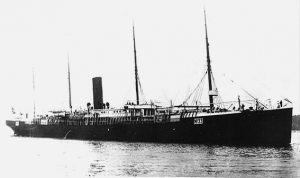 On 28th January 1886 Belgic suffered a broken piston rod and was delayed eight days at Yokohama for repairs. At Amoy, China, on 26th May 1894, Belgic was struck amidships by Blue Funnel’s Ulysses. The damage was above the waterline and she sailed the next day, arriving at San Francisco on 18th June. On 8th September 1895 Belgic went ashore in Sateyama Bay in Japan. Refloated on 10th October 1895 she sailed to Yokosuka for temporary repairs. She returned to Hong Kong, arriving on 4th November, and remained there until January while repairs were completed.
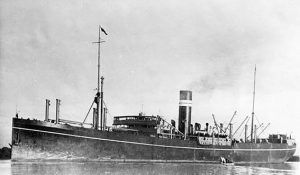 NALGORA of British India. She was 6,600grt, and 433 feet long, built by William Gray in 1922. Built to carry grain or cotton in bulk, she had no passenger accommodation. Whilst in Convoy OB 261, from Leith to Alexandria, she was sunk by stern torpedo and 70 rounds from deck gun from the German submarine U-65 in position 22°24’N 21°11’W at 22.07 hours , 350 miles north of the Cape Verde Islands. All crew survived.
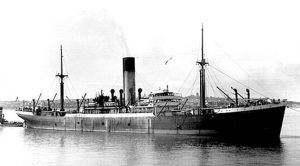 MERIONES of China Mutual. She was 7,557grt and 455 feet long, built by Palmers at Newcastle in 1922. She was in a convoy heading for Hull to complete loading cargo before heading for Australia. She grounded on a wreck on 22nd January 1941 and was abandoned. The crew were rescued by the Cromer lifeboat. Bombed by aircraft and sunk in position 52°53’N 01°47’E 26th January 1941, off Cromer.
 STX France, based at St Nazaire in France, specialises in building large cruise ships. It is part of the troubled Korean shipbuilding conglomerate STX, which is currently in receivership. The Seoul bankruptcy court stated in November that four parties had expressed interest in taking over the French part of STX, but it has since confirmed that currently only one bid has been received. This is from the Italian shipbuilder Fincantieri.
 In spite of an apparently healthy order book, including the two recent orders from MSC, other yards have been hesitant to make a bid for the profitable shipbuilder. One of these, French naval contractor DCNS, admitted they had held talks with Fincantieri and were presently keeping their options open. Getting Hong Kong announced it was no longer interested.
 The French government has a 33% stake in STX France, but has made public that it is not interested in getting a majority stake. However, it insisted that it would be retaining its blocking powers on any changes, and would have a say in any ownership change. The French Industry Minister insisted that France would maintain its right to veto any sale if the conditions weren’t right.
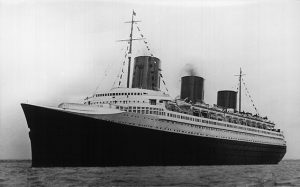 Following the Japanese attack on Pearl Harbor, on 22nd December 1941 Normandie was transferred to the US Navy Department, under the name of USS Lafayette, listed as AP53. To all who knew her, however, she would always Normandie. On the 24th December the Commission handed the liner to the US Navy, to to be hastily converted into a troopship, based on experiences gained with Queen Mary and Queen Elizabeth. The American need for troopships helped to speed up the bureaucracy. She was officially entered on the register on 1st January 1942.
 Plans were quickly put in hand for her conversion. Initially 18,000 bottles of wine were removed, along with many other items including six grand pianos, four hobby horses and other fixtures and fittings, most of which were later sold at public auctions. 2,400 vans were needed – transport costs alone were put at more than $100,000. Major works of art were carefully removed to storage, panelling was dismantled. Several local warehouses were rented for the storage. Robins Drydock was awarded the contract to convert her to a troopship, the work to be carried out while she was still at her pier. Sadly, following a number of bizarre decisions and careless workmen, on 9th February 1942 she caught fire, and later that day capsized. Too badly damaged and too big to be salvaged at the time, she was eventually scrapped in October 1946.
 Cunard’s Ivernia was built by Swan, Hunter & Wigham Richardson at Newcastle. She was launched on 21st September 1899, and made her maiden voyage from Liverpool to New York on 14th April 1900. There was an almost identical sister ship, Saxonia. Ivernia ran aground in thick fog off Daunts Rock on 24th May 1911, but was salvaged and later rebuilt. She returned to service on 17th October 1911. She was later used on the emigrant service from Trieste to New York.
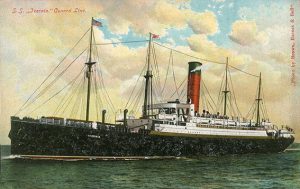 With the outbreak of the Great War in August 1914, Ivernia was hired by the UK government for use as a troop transport, mainly between Canada and the Mediterranean. On 28th December 1916 she sailed from Marseilles for Alexandria, Egypt, with HMS Rifleman as her escort. Carrying over 2,400 troops, mainly from the Argyle and Sutherland Highlanders, she was under the command of Captain Turner, who had previously been in command of Lusitania when she was torpedoed. On 1st January 1917 she was south-east of Cape Matapan, Greece, when she was torpedoed by the German submarine UB47. The torpedo hit on the starboard side and exploded in a boiler room, killing 22 of the crew. HMS Rifleman drew alongside and took off 666 troops and 36 crew, Other survivors were rescued by escorting trawlers. The ship sank soon after. Total casualties were 84 troops and 36 crew lost.