
 On 29th July 1914, Kronprinz Wilhelm arrived in New York and proceeded to refuel and reprovision as usual. Two days later NDL ordered her to load additional large amounts of coal and fresh water. Then on 1st August NDL cancelled Kronprinz Wilhelm’s next sailing scheduled for 4th August. In the meantime they continued to load fuel wherever they could. Portholes and windows were sealed and blacked out. She then sailed, to become one of Germany’s armed raiders, seizing a number of vessels.
 On 14th January Captain Thierfelder seized the Nelson liner Highland Brae, on passage from England to Buenos Aires with two thousand tons of coal, five hundred tons of fresh water and additional provisions. The passengers were transferred to Kronprinz Wilhelm. This meant that the raider now had some 219 prisoners on board that needed guarding and were consuming the limited supplies of food and water.
By 24th January Highland Brae was alongside, and the crew offloaded coal, provisions and fresh water as fast as possible, in spite of a deteriorating sea. After a break for bad weather the two ships came back alongside on the morning of 29th January, and the remaining coal and provisions were transferred. By late afternoon of Saturday, 30th January everything useful had been transferred, and soon after Highland Brae was scuttled by opening the seacocks.
After a successful time as a raider, time ran out for Kronprinz Wilhelm. Thierfelder timed his arrival off Chesapeake Bay for after dark on Saturday, 10th April. Once anchored, the ship and its crew were interned.
Extracted from “The German Greyhounds” – for more details see http://wp.me/P82xkB-40
 On 14th January 1899 Oceanic (yard number 317) was launched at Harland & Wolff,. She was designed as a twin-propeller, steel-hulled vessel, with two sets of triple-expansion engines producing 28,000hp. Accommodation was 300 First Class, 190 Second Class and 1,000 Third Class.
 On 26th August she left Belfast for Liverpool. Oceanic sailed from Liverpool on her maiden voyage on 6th September, with 1,456 passengers. However, because many of the stokers were untrained, she made the crossing with the engines operating at 75% of their potential and arrived at Sandy Hook on 15th September, at an average 19.57 knots. Oceanic left New York on 20th September on the return leg.
 On 8th September Oceanic was on patrol. The naval captain, William Hayter, ordered a course to pass between the island of Foula and the Shaalds. The White Star captain, Henry Smith, strongly advised against going into such shallow water, but was over-ruled. Subsequently Oceanic ran aground: the crew were quickly transferred to Alsatian. It proved impossible to pull her off the rocks, and in the end it was accepted she was a total constructive loss. The guns and ammunition were removed and the instruments dismantled. Amazingly, at the later enquiry both captains were absolved of all blame!
 13th January was twice a significant date in Normandie’s history, and both were connected with fires on Normandie. The first was in 1935: there had been several incidents of sabotage reported in the final months of her fitting out. On 13th January 1935 a patrolling supervisor noticed some panelling in a corridor was loose: behind them he found the electrical wiring had been tampered with, enough to create a series of short-circuits and possibly start a fire. Some of the electrical conduits had needles inserted, others had been cut and some had been removed entirely. The supervisor raised the alarm, then quickly assembled a specialist team of skilled electricians who checked and repaired every conduit throughout the ship. It was never discovered who had caused the damage or why.
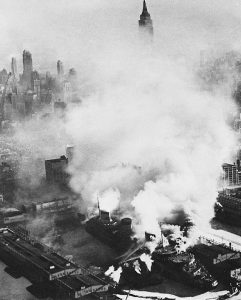 The second incident was on 13th January 1942. A survey had been ordered into the ability of the ship to fight a fire. The survey, by Walter Kidde & Co., was very superficial – they only checked a few of the hundreds of extinguishers on board, before declaring that they were not built ‘according to American design’, and recommended that all be replaced with American units. However, nothing was put in hand. The comprehensive fire alarm system had been disconnected. And tragically the ship-to-shore fire alarm link to the New York City Fire Department had been cancelled once Normandie was taken over, and the Navy didn’t consider it necessary to replace it.
 All the French-made hose couplings on the water main for the firefighting system were being changed to American-pattern couplings: workers ignored an instruction to retain compatible couplings, so a mixture developed of different couplings, although the original fittings on the hoses remained. Most of the French firemen had left when the US took over the ship: the civilian ‘fire watchers’ that replaced them were totally untrained in the equipment aboard or emergency procedures. This created confusion and mayhem. And the result was the devastating loss of Normandie!
 On 13th January 1915, the armed merchant cruiser HMS Viknor disappeared off the Irish coast, with no distress messages ever heard. It was later assumed she hit a mine and was a sudden, devastating loss.
 She was launched in September 1888 as RMS Atrato, by Napier & Son in Glasgow, for the Royal Mail Steam Packet Co. When completed she was a single screw steamer fitted with a three-cylinder triple-expansion engine but was also rigged as a three-masted schooner. She displaced 5,386 tons, and was 421 feet long. With her clipper bow and raking masts, she looked more like a luxury yacht. She could carry 176 First Class passengers and 400 in steerage, on the service between Southampton and South America, and then to the Caribbean. The maiden voyage was on 17th January 1889, to Buenos Aires. In October 1912 she was sold to Viking Cruising Company of London and renamed Viking, to operate cruises in northern Europe.
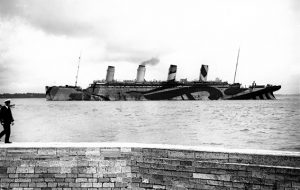 Olympic arrived at Belfast on 12th January 1917 for a three months’ refit, which included fitting six 6-in guns, with 40 Royal Naval ratings allocated. Two guns were mounted on the fo’castle, two in the forward well deck and two aft on the poop deck. She had a new dazzle camouflage scheme designed by the war artist Norman Wilkinson, one of several patterns she sported during the war. During the overhaul, Captain Hayes was given temporary command of Celtic.
 Following the aborted voyage on Celtic, Captain Hayes commanded Adriatic on one voyage to New York then returned to command of Olympic. On 4th April 1918 Olympic was re-commissioned. She was due to sail from Greenock for Halifax with all cabins full and over 2,000 passengers. However she was held for several days waiting for a political delegation headed by Arthur J. Balfour, British Foreign Secretary and head of the British Mission to the United States. On 2nd June Mr Balfour and his mission boarded Olympic at Halifax for the return voyage. Captain Hayes was later awarded the CMG for this duty.
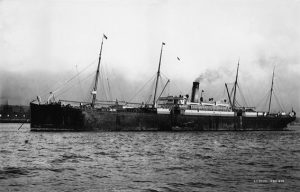 On 12th January 1894, White Star’s Cevic sailed on her maiden voyage from Liverpool to New York. She had been launched on 23rd September 1893 at Harland & Wolff, as yard number 270. Built as a large cattle carrier, she could carry 800 head of cattle and 20 horses, as well as having a large cargo capacity. She sailed from New York on 30th January 1894, with what was claimed to be the largest cargo to leave the port at that time. On 1st February she rescued the crew of a sinking brig, W.G. Gordon. En route from Liverpool to New York, on 15th November 1895 Cevic encountered a 90mph gale which tossed the ship so violently that barrels in the hold broke loose!
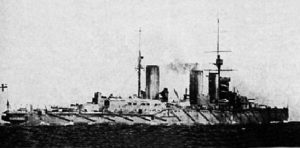 She was requisitioned by the Admiralty in October 1914, and was sent to Belfast, where she was converted into a dummy battleship, HMS Queen Mary. This was as part of a fleet of merchant ships converted to resemble various warships. After grounding twice she finally left Belfast on 13th April 1915. The disguised warships were not particularly successful, and in September 1915 Cevic was purchased by the Admiralty and converted into a Royal Fleet Auxiliary tanker. Renamed Bayol, she was renamed again in 1917, becoming Bayleaf. On 18th February 1918 she was severely damaged by bad weather and repairs took over three months. In June 1920 she was purchased by British Tanker Co. then re-sold to Anglo-Saxon Petroleum and renamed Pyrula. By November 1921 she was a floating depot ship in New York harbour, and by September 1925 she was being used as a hulk at Curacoa, as a bunker ship. Finally on 25th July 1933 Pyrula was sold to Henrico Haupt and scrapped at Genoa.
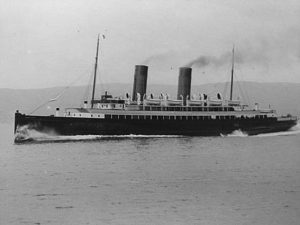 Ben-My-Chree (Manx language meaning “Girl of my Heart”) was a packet turbine steamer between Liverpool and Douglas on the Isle of Man. She was built by Vickers in 1907, She was 390 feet long, with five decks, and could carry 2,549 passengers, entering service in August 1908.
 She was chartered by the Royal Navy in January 1915, and was sent to Cammell Laird at Birkenhead where she was converted into a seaplane carrier. A large hangar was built aft, that could house between four and six seaplanes. Derricks were used to lift the aircraft in and out of the water. Initially there was a 60-foot dismountable take-off platform installed forward of the superstructure but this was soon removed..
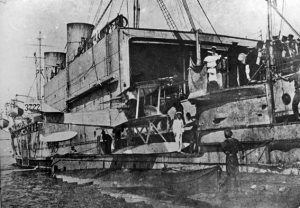 Once converted, she was initially assigned to the Harwich force, and took part in two abortive raids on Norddeich. Following this, she sailed for the Dardanelles, with two Short 184 torpedo bombers. She was at Lesbos by June 1915. Over the following months the seaplanes were mainly used as spotters for the naval artillery supporting the troops ashore, and also the occasional torpedo attack.
 On 20th December 1916 Ben-My-Chree was sent to the Greek island of Kastellorizo to support French troops fighting the Turks. The Turkish battery opened fire on the steamer, disabling her steering and starting a fire that quickly spread. The crew abandoned ship, and the Turks continued firing until the steamer sank in fairly shallow water. The wreck was refloated in 1920 and towed to Piraeus. After survey it was declared a constructive total loss and was eventually broken up in Venice in 1923.
 In 1881 two new ships were ordered from Harland & Wolff: these were to be Ionic and Doric, designed and built for the immigrant service to New Zealand. Ionic (yard number 152) was launched on 10th January 1883, as a 4-masted barque-rigged freighter, with accommodation for 70 passengers, and the first engines built by Harland & Wolff for White Star, as four-cylinder compounds.
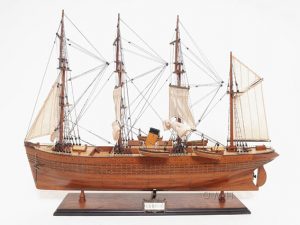 Gaelic left Liverpool on her maiden voyage on 29th January 1873, bound for Valparaiso, Chile, with calls at Pauillac, Vigo and Lisbon to embark passengers and cargo. She made the first of eight north Atlantic crossings on 10th July 1873 from Liverpool, and arrived in New York on 22nd July. In 1874 Gaelic was switched from Liverpool to London and made the first of four round-trip sailings on 3rd June. She later reverted to the Liverpool route.
 In 1858, when T.H. Ismay reached 21, he and Philip Nelson set up business as shipbrokers, trading as Nelson, Ismay & Co. T.H. Ismay married Margaret Bruce in Liverpool on 7th April 1859. Nelson, Ismay ordered their first ship, from Alexander Stephen on the Clyde in 1858, and in the following years purchased several more vessels. On 1st April 1862 Philip Nelson retired and the firm was dissolved. Ismay continued with ship and insurance brokering, as T.H. Ismay & Co.
 Gustav Schwabe introduced Ismay to Gustav Wolff, his nephew, and Edward Harland, who were building steamships at Belfast. Schwabe proposed to Ismay that, if he had all his vessels built at the Belfast yard, he would back Ismay in establishing a new shipping company. On 30th July 1868 T.H. Ismay’s White Star Line and Harland & Wolff finalised an agreement to build three steamers. Soon after Oceanic Steam Navigation Co. Ltd was formally registered on 6th September 1868, with an initial issue of 400 shares of £1,000 each. The new company was to concentrate on the north Atlantic.
 After several successful years, on 21st December 1891 T.H. Ismay resigned from Ismay, Imrie, with his sons Bruce and James joining the board; he remained as chairman. Ismay was summoned to the Foreign Office on 16th June 1897 and was informed that Queen Victoria wished to confer a baronetcy on him. However, the honour was declined.